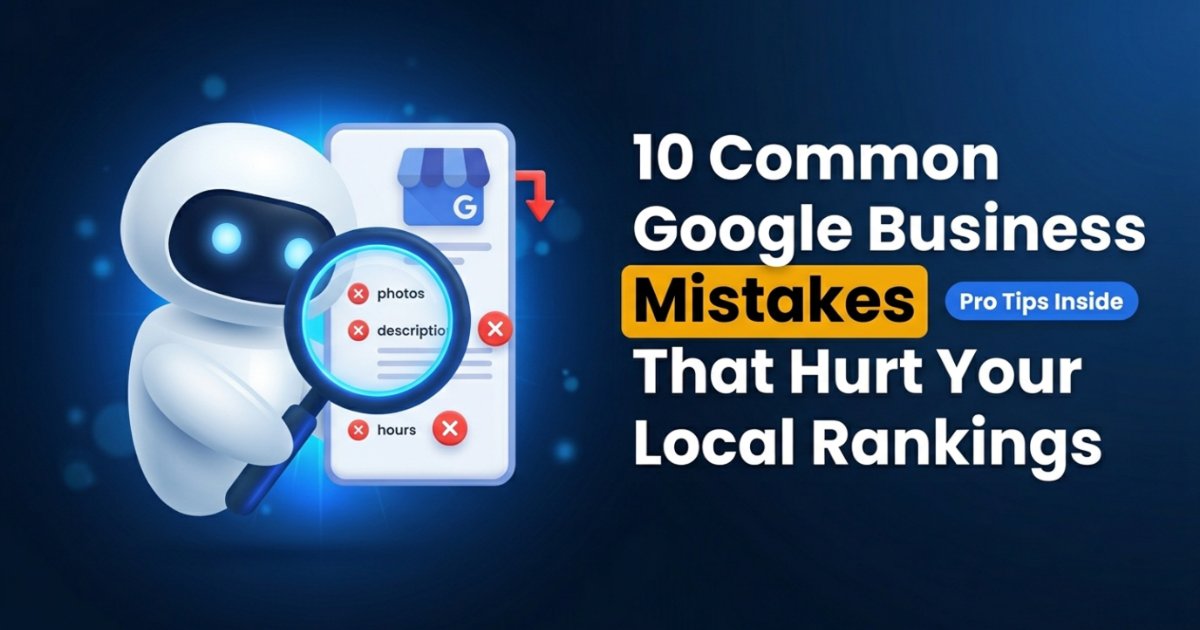
10 Common Google Business Profile Mistakes That Hurt Your Local Rankings
Last month, I audited a multi-location dental chain's Google Business Profiles. Fourteen locations, all managed by the same team, and somehow every single one had a different address format. "Suite" vs "Ste." vs "#" vs nothing at all. Their review response rate? Under 20%. They'd been bleeding local visibility for months and blamed "the algorithm." It wasn't the algorithm. It was death by a thousand small, fixable mistakes.
By the end of this guide, you'll know exactly which GBP errors are silently tanking your local rankings—and how to fix each one without nuking your profile in the process.
Before You Touch Anything: The Pre-Flight Check
You need three things ready before making changes:
- Access to your GBP dashboard (owner-level, not just manager)
- A spreadsheet of your business name, address, and phone number as it appears on your website, Yelp, Apple Maps, and at least 7 other directories
- Your Google Analytics hooked up with UTM tracking on your GBP links
Stop/Go test: Can you log into your GBP right now and confirm your listed phone number matches your website's footer exactly? If not, stop here and get access sorted first.
The 10 Mistakes (And How to Actually Fix Them)
Mistake 1: NAP Inconsistencies Across Directories
This is the silent killer. Over 70% of unoptimized profiles have NAP consistency issues, and most business owners don't even realize it. "Street" vs "St." — that's enough to confuse Google's trust signals.
What to do: Run a citation consistency audit across 50+ directories using a tool like Moz Local or BrightLocal. Fix every single variance. Yes, even the abbreviations.
Visual checkpoint: When your audit tool shows 100% match across all tracked directories, you're good. Any yellow or red flags mean you're not done.
Verification: Manually spot-check 5 random directories. If even one doesn't match, your bulk update didn't propagate fully.
Friction warning: If you're running bulk operations across dozens of listings, stagger your changes over 2-3 weeks. Updating everything simultaneously can trigger algorithmic suspicion—I've seen it tank rankings for a full month.
Mistake 2: Wrong Primary Category
Your primary category isn't a "best guess" situation. Wrong primary category limits visibility for roughly 80% of mismatched searches. A "Restaurant" tagged as "Food Service" is invisible for "restaurants near me."
Match your primary category to your main revenue driver. Period. Use secondary categories for the long-tail stuff.
Visual checkpoint: In your GBP dashboard, your primary category appears first and bold under your business info section.
Mistake 3: Ignoring Review Management Entirely
Here's where most businesses completely fall apart. They'll spend hours on photos and posts but let reviews—the single strongest trust signal—rot unanswered.
Active review management isn't optional. Businesses with complete, actively managed profiles get 7x more clicks than incomplete ones. And review velocity matters more than total count. Google prioritizes recency.
What to do: Respond to every review within 24-48 hours. Use response templates as starting frameworks, but personalize each reply. A canned "Thanks for your feedback!" reads as hollow to both customers and Google's review sentiment analysis.
Verification: Pull up your review analytics & reporting. If your average response time exceeds 48 hours or you have unanswered negatives, that's your priority today.
> Struggling to keep up with reviews across locations? For multi-location management, a centralized dashboard like GMBMantra automates review responses using sentiment analysis while letting you customize tone per location. It handles the review analytics & reporting piece so you're not flying blind.
Mistake 4: Map Pin Drift
This one's sneaky. Your map pin can drift from your actual entrance, and pixel-level offsets have dropped businesses from the local 3-pack. I'm not exaggerating.
Fix: Upload a 360-degree photo pinned to your exact storefront entrance. Then manually verify pin placement in the dashboard.
Visual checkpoint: Open Google Maps, search your business, and confirm the pin sits directly on your door—not the parking lot, not the building next door.
Mistake 5: Keyword Stuffing Your Business Name
"Best Plumber NYC | 24/7 Emergency Plumbing | Cheap Plumber" as a business name? That's a suspension waiting to happen. Google's gotten aggressive about keyword stuffing in business names.
Your GBP name should match your legal business name. Nothing more. If you've already been suspended, you'll need to appeal with legal documentation and strip the stuffed keywords.
Mistake 6: Dead or Slow Website Links
Your GBP website link points to... a page that takes 6 seconds to load on mobile. Or worse, a 404.
Mobile-optimized sites linked to GBP see 67% more calls and 35% more directions. Tag every GBP link with UTM tracking for granular ROI measurement in GA4. And make sure the landing page actually matches the category and services listed on your profile.
Visual checkpoint: Click your own GBP website link on a phone. Does it load in under 3 seconds? Does the content match what your profile promises?
Mistake 7: Neglecting Google Posts
No Google Posts means you're cutting engagement by 30-50%. That's not a typo.
Schedule posts weekly with clear CTAs. Promotions, updates, events—anything that signals to Google your business is active and engaged.
Verification: Check your Posts carousel on your live profile. If the most recent post is older than 7 days, you're losing ground.
Mistake 8: Incomplete Attributes
Attributes like "wheelchair accessible," "free WiFi," or "outdoor seating" feed Google's entity-based filtering for niche, long-tail queries. Skipping them means you're invisible for near-me searches with specific intent.
Stack every relevant attribute. Don't guess—check what competitors in your category are using.
Mistake 9: Ignoring Duplicate Profiles
Ghost errors from unclaimed duplicate profiles can suppress your main profile's authority entirely. You might not even know they exist.
Fix: Search variations of your business name, old addresses, and phone numbers. Find duplicates? Merge them via a Google support ticket. This alone has rescued rankings for clients I've worked with.
Mistake 10: No Reputation Protection Strategy
Negative review sentiment tanks trust scores faster than almost anything else. And if you're managing multiple locations without team permissions and a clear escalation process, bad reviews slip through the cracks constantly.
You need a reputation protection system—not just reactive responses, but proactive monitoring with review analytics that flag sentiment dips before they snowball.
The Ugly Truth: Ghost Errors That Won't Show Up in Any Official Guide
Problem | The Weird Fix | Source |
|---|---|---|
Sudden rank drop despite no changes | Search name variations for unclaimed duplicates; merge via support ticket | Community forums, BrightLocal |
Zero impressions after full optimization | Map pin offset—upload 360 photo pinned to exact entrance; reverify | Local SEO practitioner reports |
Verification fails repeatedly | Use live video call verification, especially for Service Area Businesses | Google support community |
Bulk edits crater rankings overnight | Stagger all changes over 30 days minimum | Practitioner testing |
SAB leaking home address | Video verify, hide address, limit service areas to 2-hour drive radius | GBP forums |
Making This Manageable at Scale
If you're running 2 or 3 locations, a spreadsheet and weekly calendar reminders might cut it. But once you're past that—say, 10+ locations—the operational load of review management, consistent posting, and NAP monitoring across directories becomes genuinely unmanageable without systems.
This is where a centralized dashboard with team permissions and bulk operations capability stops being a luxury and becomes infrastructure. GMBMantra was built specifically for this—AI-powered response templates that adapt to review sentiment, multi-location management from a single view, and the kind of review analytics & reporting that tells you which location is slipping before it hits your rankings.
FAQs
How long before GBP fixes actually improve rankings?
Initial fixes like NAP corrections and category changes typically show movement in 2-4 weeks. Review velocity compounds over 1-3 months. Full authority build with consistent posts and reviews takes 6-9 months. Don't expect overnight miracles—but the early wins come faster than most expect.
How do I fix a suspended Google Business Profile?
File a reinstatement appeal with legal business documentation. Remove any keyword stuffing from your business name, disavow spammy backlinks through Google Search Console, and ensure your profile information matches your legal registration exactly. Expect 7-14 days for review.
Why aren't my reviews improving my local rankings?
Low review velocity is usually the culprit. Aim for 5+ new reviews monthly and respond to every single one—positive and negative. Google weighs recency and engagement patterns, not just star averages. Use automated review request workflows to maintain consistent velocity without manual chasing.
Can changing my primary category cause a ranking drop?
Yes, temporarily. Swapping categories can trigger a re-evaluation period of 7-14 days. But if your current category is wrong, the short-term dip is worth the long-term correction. Don't let fear of a temporary drop keep you locked into the wrong category.
So—which of these mistakes is your profile making right now? Pick the one that made you wince and fix it today. Not next week.