What Is Google Business Profile and Why Every Local Business Needs It in 2026
I was three weeks into a client's local SEO campaign when their Google Business Profile just… vanished from Maps. No warning. No suspension email. A classic ghost ban triggered by a NAP mismatch between their website footer and a stale citation on Yelp. I spent an entire afternoon running a profile audit across 50+ directories before the listing resurfaced. That one incident changed how I approach every single local business engagement now.
Here's what this guide gives you: a practitioner-tested system to set up, optimize, and maintain your Google Business Profile so it dominates Search, Maps, and AI Overviews in 2026—without the nasty surprises.
Pre-Flight: What You Need Before Touching Your Profile
Before you log into the GBP dashboard, get these locked down:
- A NAP spreadsheet. Your exact business name, address, and phone number—formatted identically everywhere. One abbreviation difference ("St." vs "Street") can trigger penalties.
- 20+ high-resolution photos. Not stock images. Real photos of your storefront, team, products, and completed work. AI image interpretation now scans these for relevance signals.
- Your primary and secondary categories decided. Don't wing this. Search your competitors first.
- LocalBusiness schema ready on your website's CMS. WordPress, Webflow, whatever—have it prepped.
- Access to Google Search Console and Analytics, linked to your domain.
Stop/Go test: Can you recite your exact business name, address, and phone number without checking three different sources? If not, stop. Fix that first.
Phase 1: Claim, Verify, and Nail the Basics
Step 1: Go to google.com/business and either claim your existing listing or create one from scratch. Use your exact legal business name—no keyword stuffing. Google's stricter enforcement in 2026 means profiles with "Best Pizza NYC" appended to a business name get suspended fast.
Step 2: Select your primary category carefully. If you're a plumber, set "Plumber" as primary, then layer secondary categories like "Emergency Plumbing Service" or "Water Heater Installation." This determines which searches you appear in.
Step 3: Define your service areas precisely. Only claim locations you actually serve. Overclaiming triggers rank suppression.
Step 4: Request verification. Postcard, phone, or video—whichever Google offers for your business type.
Visual checkpoint: You'll see a blue "Pending Verification" banner across your dashboard. Once verified, a green "Verified" badge replaces it.
Verification test: Search your business name + city in an incognito browser. Your listing should appear in the right-hand knowledge panel with your correct address and phone number.
Here's the friction most guides skip: verification can take 5-14 days by postcard, and if your address doesn't match what's on file with USPS or your local postal system, the postcard may never arrive. I've seen this stall launches by weeks.
Phase 2: Profile Optimization That Actually Moves Rankings
This is where most businesses phone it in—and where you pull ahead.
Attributes stacking. Under the "More" tab, add every relevant attribute: "Wheelchair Accessible," "Women-Owned," "Veteran-Led," "Free Wi-Fi," whatever applies. Post-Q&A retirement, attributes are what Gemini parsing pulls from when someone asks "Does this place have outdoor seating?" in Ask Maps. Miss these, and the AI gives a generic non-answer. Use a business attributes strategy to maximize visibility.
Photo management matters more than ever. Upload at minimum 20 photos—exterior, interior, team shots, product close-ups. Google's AI image interpretation now extracts context from visuals without relying on filenames or alt text. A blurry phone pic of your storefront tells the algorithm nothing. High-res images of actual completed work? That's expertise signal gold.
Write your business description in chunked, declarative sentences. Not marketing fluff. "We provide emergency plumbing repair in Austin, TX. Our team handles water heater installation, drain cleaning, and pipe replacement." Gemini parses this structure directly into AI Overviews.
Visual checkpoint: Preview your profile in incognito mode on Maps. You should see attribute badges displayed beneath your business name, a photo carousel with your uploaded images, and an AI-generated summary pulling from your description and services.
Verification test: Ask a friend to search "\[your service\] near me" on their phone. If you're in the top 3 results with photos and attributes visible, your profile optimization is working.
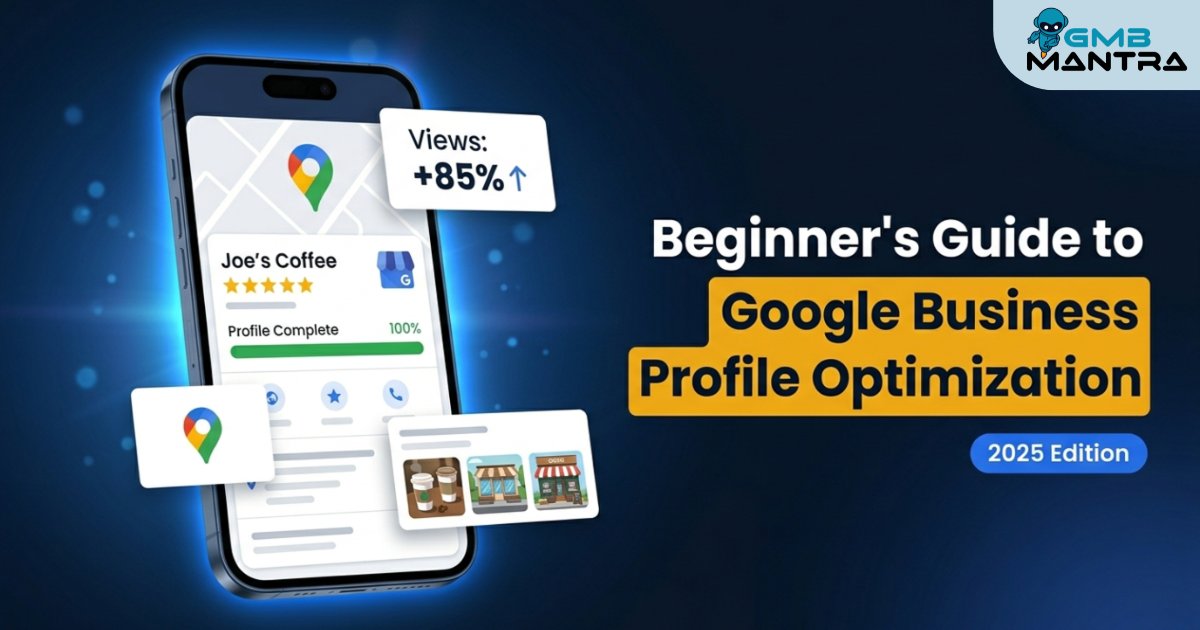
The data backs this up: complete GBP profiles drive 7x more clicks than incomplete ones, and businesses with fully optimized listings see 2.7x higher credibility scores in Google's own research.
Phase 3: The Ongoing Engine—Posts, Reviews, and Signals
Setting up your profile is maybe 30% of the work. The other 70% is maintenance that most businesses abandon within a month.
Post scheduling is non-negotiable. Weekly posts—offers, events, updates—send freshness signals that Google now weights heavily for local rankings. A profile with no posts for 30+ days gets deprioritized. I've watched it happen in real time on rank tracking dashboards. Smart post creation doesn't need to be elaborate: a photo, two sentences about a current offer, and a CTA button. You can automate Google Business Profile posts to keep your profile active without manual effort.
Review velocity is your new ranking lever. With Q&A retired, reviews carry even more weight. Print QR codes on receipts. Send follow-up texts with your "Ask for Reviews" link. Aim for at least 5 new reviews per week. And respond to every single one—positive and negative. AI review responses need to feel personal, not templated, because Google's sentiment analysis can detect generic copy-paste replies.
Enable messaging and respond fast. Google tracks your response time. Anything over 5 minutes consistently, and you risk a discoverability penalty. Auto-forward messages to Slack or your phone.
Visual checkpoint: Your Insights tab should show increasing discovery searches, photo views climbing, and a post impression graph trending upward week over week.
Verification test: Check your review response rate in the dashboard. It should be 100%. Check your average messaging response time—under 5 minutes gets you the green checkmark.
> Tired of managing all this manually? If you're running rank tracking, citation management, and review responses across separate tools, that's where the wheels fall off. GMBMantra consolidates profile optimization, AI review responses with real sentiment analysis, smart post creation, and post scheduling into a single dashboard. It's the tool I recommend when businesses hit the "I can't keep up with this" wall—especially for multi-location management where manual updates across branches cause exactly the kind of NAP desync that triggers ghost bans.
The Ugly Truth: Problems Nobody Warns You About
Problem
The Weird Fix
Context
Profile invisible in Maps (ghost ban)
Bulk-edit NAP via GBP dashboard, then resubmit to 50+ directories. Wait 7-14 days.
NAP inconsistency across citations is the #1 cause
AI Overviews show wrong info about your business
Add chunked declarative sentences to services; upload 20+ AI-scannable photos; implement FAQ schema
Incomplete attributes cause AI mismatches in 50%+ of cases
Sudden local ranking drop
Check messaging response times. Auto-forward to Slack, respond under 5 minutes consistently
Slow responses now directly hurt discoverability
Reviews not influencing rank
QR code campaigns targeting 5 reviews/week. Respond to every review within 24 hours
Low review velocity post-Q&A retirement kills momentum
Multi-location profiles out of sync
Assign one owner account. Use API or bulk tools for NAP and service updates
Manual per-branch edits guarantee drift
FAQ
How long before my Google Business Profile shows up in local results?
Initial visibility takes 1-2 weeks post-verification. Consistent weekly posts and steady review velocity push you into the top Maps positions within 4-6 weeks. AI Overviews dominance and that 7x click benchmark? Expect 3-6 months of disciplined maintenance.
Can competitor analysis actually help my GBP ranking?
Yes. Studying competitors' primary categories, attribute stacking, review volume, and post frequency reveals gaps in your own profile. If a competitor has 200 reviews and you have 12, no amount of photo management closes that gap without a review velocity strategy.
What's the fastest way to recover from a GBP suspension?
Strip your business name back to its exact legal name—no added keywords. Submit an appeal through GBP support with proof documents (utility bill, business license). Simultaneously audit your citation management across all directories to eliminate mismatches that triggered the flag.
Does photo management really affect local SEO in 2026?
Absolutely. Google's AI image interpretation extracts service context, location cues, and expertise signals directly from your photos. Businesses with 20+ high-quality images consistently outperform those with stock photos or fewer than 5 uploads.
How do AI review responses differ from manual ones?
AI-powered review responses use sentiment analysis to match tone—apologetic for negative reviews, enthusiastic for positive ones. The key is personalization. Tools like GMBMantra's AI response engine generate replies that reference specific details from each review, which builds trust signals far better than generic templates. This is a top-tier Google Review Management approach.
Is post scheduling worth the effort for small businesses?
A profile without fresh posts for 30+ days gets deprioritized. Period. Even one post per week with a photo and a short update maintains your freshness signal. Automate your post scheduling if manual consistency is the bottleneck—because for most businesses, it is.
Your Google Business Profile isn't a "set it and forget it" listing anymore. It's a living, AI-parsed asset that either works for you every single day—or quietly disappears. The businesses winning local search in 2026 are the ones treating their GBP like a product, not a chore.
> Your next move: Run a full profile audit with GMBMantra to catch the gaps you can't see manually—before Google's AI does.