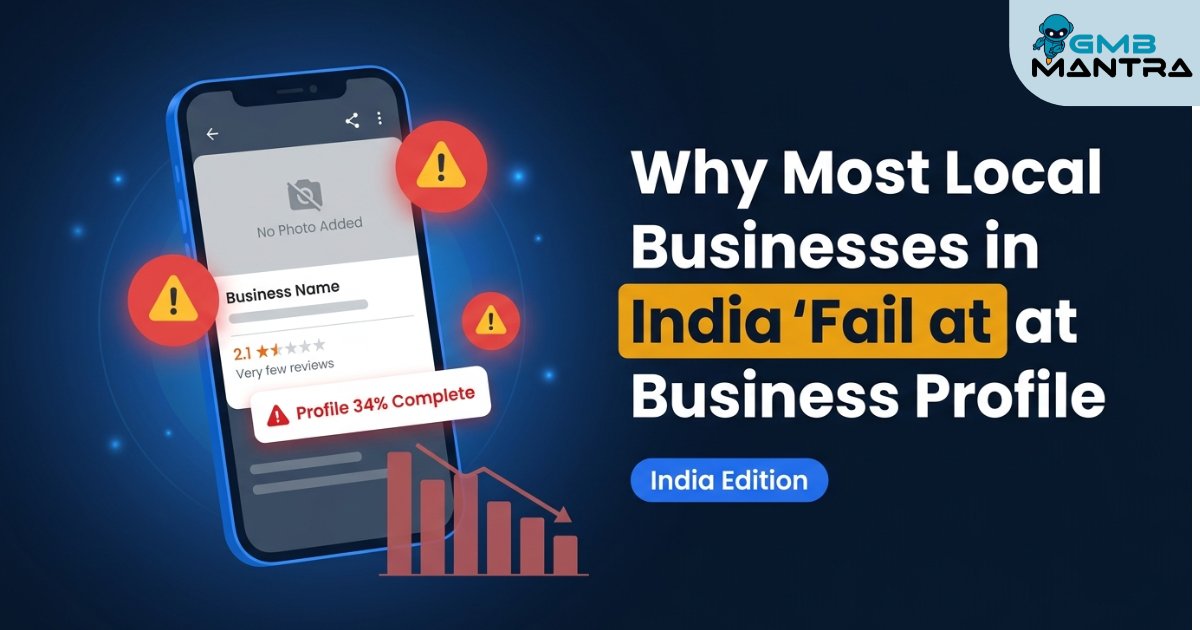
Why Most Local Businesses in India Fail at Google Business Profile Optimization
Why Most Local Businesses in India Fail at Google Business Profile Optimization (And How to Fix It)
I was reviewing GBP profiles for a dental clinic in Bangalore last month when I noticed something alarming. Their profile had 4,200 search impressions but only 37 clicks. That's a 0.88% click-through rate—abysmal by any standard. When I dug deeper, the problem wasn't technical. They'd "completed" their profile, uploaded photos, even responded to a few reviews. But they'd missed the actual optimization work that converts impressions into appointments.
This isn't unique. Most Indian local businesses treat their Google Business Profile like a one-time setup task rather than a dynamic local SEO asset. By the end of this guide, you'll understand the specific optimization gaps killing your local visibility and exactly how to fix them.
The Pre-Flight Check: Are You Ready to Optimize?
Before we dive into the execution, you need three things locked down:
1\. Admin Access to Your GBP Dashboard Not "manager" access—full admin rights. You can't audit profile completeness or access GMB Insights without it.
2\. A Clear ICP Definition Can you describe your ideal customer in one sentence? If not, stop. You can't optimize keyword placement or service categories without knowing who you're targeting.
3\. Baseline Metrics from the Past 28 Days Open your Insights dashboard. If you see zero data for search queries, calls, or website visits, you need to wait until Google has enough data to analyze. Optimization without a baseline is guesswork.
Stop/Go Test: Open your GBP profile right now. Count how many of the 27 available fields are completely filled with accurate information. If you're below 75%, pause and complete your profile before moving forward.
Phase 1: The Profile Completeness Trap
Here's what most businesses get wrong: they think "complete" means filling out the business name, address, and phone number. That's not optimization—that's the bare minimum to exist.
The Directive: Audit every single field in your GBP dashboard. This includes:
- Business description (750 characters maximum—use all of it)
- Service categories (primary + 9 secondary)
- Business attributes (payment methods, accessibility features, free Wi-Fi)
- Service menu with individual descriptions
- Products section (if applicable)
- Appointment booking link
- Q&A section (seed 3-5 questions yourself if none exist)
Visual Checkpoint: When you're done, your profile should show a "Profile Strength" indicator at 100%. More importantly, every section on the public-facing profile should display content—no empty modules.
The Verification: Search your business on Google Maps from an incognito window. Click through every tab (Overview, Reviews, About, Posts). If you see any section that says "No information available," you're not done.
Expert Nuance: The business description field is where most Indian businesses lose the keyword optimization game. They write flowery brand stories instead of service-focused copy. Your description should mention your primary service, location, and one differentiator in the first sentence. Save the brand story for your website.
Friction Warning: Profile completeness doesn't guarantee visibility. Research shows that 40% of local businesses leave critical fields blank, but even those who complete everything often miss the quality threshold. A generic "We provide excellent service" description won't rank against a competitor who writes "24/7 emergency dental care in Indiranagar with same-day appointments."
Phase 2: The Photo Management Disaster
I've seen healthcare clinics with three blurry photos uploaded in 2019. Fitness studios with zero interior shots. Salons with stock images instead of actual work samples.
Google's algorithm prioritizes recency and visual diversity. Businesses with 10+ photos updated within the last 90 days see 42% higher engagement velocity than those with static galleries.
The Directive: Upload at least 15 photos across these categories:
- Exterior (storefront with clear signage)
- Interior (waiting area, service spaces, equipment)
- Team (staff members in action, not posed headshots)
- Work samples (before/after for salons, treatment rooms for clinics, equipment for gyms)
- Customer interactions (with permission)
Every photo must be:
- High-resolution (minimum 720px width)
- JPEG format under 5MB
- Properly lit (natural or professional lighting)
- Tagged with descriptive alt text in the file metadata
Visual Checkpoint: Your photo gallery should load with recent uploads (marked "1 week ago" or "2 weeks ago") displayed first. If photos from six months ago still dominate the top row, you need a refresh cycle.
The Verification: Check your Insights dashboard under "Photo Views." If you're getting fewer than 50 views per week on a profile with 1,000+ monthly searches, your images aren't compelling enough.
The Ugly Truth: Google's indexing lag for photos can take 2-3 weeks. I've had clients panic because their new photos didn't appear immediately. The weird fix? Upload photos in batches of 3-5 every week rather than dumping 20 at once. Google's algorithm seems to prioritize accounts with consistent activity over bulk uploads.
Phase 3: Review Management (The Silent Killer)
Here's a stat that should terrify you: businesses that respond to fewer than 50% of reviews see a 23% drop in reputation score, which directly impacts local rankings. Yet, most Indian businesses either ignore reviews entirely or use generic templates like "Thank you for your feedback."
The Directive: Set up a systematic review management process:
- Solicitation: Ask for reviews within 24-48 hours of service delivery via SMS or email
- Monitoring: Set up automated alerts for new reviews (Google sends email notifications, but use a dedicated tool for multi-location businesses)
- Response Protocol: Assign one team member as the "Review Owner" with a 48-hour response SLA
- Personalization: Reference specific details from the review (service type, staff member name, complaint specifics)
Visual Checkpoint: Your review section should show response timestamps within 2-3 days of the review date. If you see reviews from last month with no response, you're failing this phase.
The Verification: Calculate your review response rate: (Total responses / Total reviews) × 100. You need 80%+ to signal active reputation management to Google's ranking algorithm.
Expert Nuance: Negative reviews aren't ranking killers—unaddressed negative reviews are. A thoughtful response to a 2-star review that explains what went wrong and how you fixed it can actually boost trust more than five generic 5-star reviews.
Phase 4: The NAP Consistency Nightmare
NAP (Name, Address, Phone number) inconsistency is the ghost error that kills local SEO rankings without leaving obvious traces. You think your information is correct because your GBP profile displays the right data. But Google cross-references your profile against hundreds of citation sources—JustDial, Sulekha, IndiaMart, industry directories, social media profiles.
The Directive: Conduct a citation audit:
- Google your business name + city
- Open the first 10 results (excluding your website and GBP)
- Document the exact NAP format on each platform
- Identify discrepancies (variations in business name, old addresses, disconnected phone numbers)
Common Discrepancies in India:
- Business name variations ("Dr. Sharma's Dental Clinic" vs. "Sharma Dental Care")
- Address format inconsistencies (Building name vs. street number first)
- Landline vs. mobile number conflicts
- Old location data from previous offices
Visual Checkpoint: Create a spreadsheet with three columns: Platform, NAP Data, Status (Correct/Needs Update). Every platform should show "Correct" before you proceed.
The Verification: Use a tool like Moz Local or Whitespark to scan for citation inconsistencies. Manual audits miss 30-40% of listings because Google indexes platforms you've never heard of.
Friction Warning: Fixing NAP inconsistencies isn't instant. Some directories take 4-6 weeks to update listings. Start this process now if you're planning a local SEO push in the next quarter.
The "Weird Fixes" Table: Community-Sourced Solutions
Problem
The Weird Fix
Why It Works
High impressions, zero clicks
Replace business description with service-focused copy in the first 100 characters
Google's mobile snippet only shows the first 100 characters—make them count
Photos uploaded but not appearing
Use JPEG format, compress to <5MB, wait 2-3 weeks
Google's image indexing prioritizes optimized files and has a processing lag
Reviews exist but no one responds
Set up automated review alerts and assign a dedicated "Review Owner"
Systematic processes beat good intentions every time
Ranking dropped suddenly
Check competitor GBP profiles weekly for optimization changes
Local rankings are relative—your competitors' improvements hurt your visibility
Services section incomplete
Add individual service descriptions with pricing (if applicable)
Schema markup pulls from service data to enhance search visibility
Why Health & Wellness Businesses Struggle Most
If you're a dental practice, gym, salon, or wellness center in India, you face unique GBP challenges. These sectors have the highest competition density in urban markets, which means optimization gaps get punished faster.
The three critical mistakes I see repeatedly:
1\. Generic Service Categories Choosing "Dentist" as your primary category when "Cosmetic Dentist" or "Pediatric Dentist" would capture higher-intent searches.
2\. Missing Appointment Integration Not linking your booking system directly to your GBP profile, forcing customers to call or visit your website (adding friction to the conversion funnel).
3\. Inconsistent Posting Health businesses post sporadically—usually during promotions—instead of maintaining a weekly content cadence that signals active engagement to Google's algorithm.
> Looking for a Faster Path to GBP Optimization? > If you're managing multiple locations or struggling with review management at scale, GMBMantra automates the heavy lifting. The platform uses AI-powered sentiment analysis to generate personalized review responses, schedules posts across all your profiles, and provides keyword heatmaps to identify optimization gaps. It's built specifically for health and wellness businesses managing local SEO across multiple locations.
The Timeline Reality: When Will You See Results?
Let's kill the "optimize once and rank forever" myth. GBP optimization is continuous. Here's the realistic timeline:
Week 1-2: Profile completion and photo uploads (implementation phase) Week 3-4: Citation cleanup and NAP consistency fixes (processing lag) Week 5-8: Review solicitation and response management (momentum building) Week 9-12: Ranking improvements become visible in Insights data (validation phase)
If you're not seeing improved search query diversity or higher engagement velocity by week 12, audit your keyword optimization and service category selection. Those are usually the culprits.
FAQ: Implementation-Focused Answers
How long does it take to optimize a Google Business Profile completely?
For a single-location business, expect 8-12 hours of focused work spread across two weeks. Multi-location businesses need a centralized dashboard and team permissions to avoid duplication—plan for 20-30 hours of initial setup plus ongoing weekly maintenance.
Do I need to respond to every single review?
Aim for 80%+ response rate. Prioritize negative reviews (respond within 24 hours) and detailed positive reviews. Generic 5-star reviews with no text can get a simple "Thank you" response.
What's the ideal photo upload frequency?
Add 3-5 new photos every month. Seasonal businesses (like outdoor gyms) should upload 5-10 photos at the start of each season to reflect current conditions.
Can I optimize my GBP profile if I don't have a physical storefront?
Service-area businesses can hide their address and define service zones. The optimization principles remain the same—focus on service descriptions, customer reviews, and consistent posting.
How do I track ROI from GBP optimization?
Use GMB Insights to monitor calls, website visits, and direction requests. Implement UTM parameters on your GBP website link to track conversions in Google Analytics. For call tracking, tools like CallRail or Twilio provide attribution data.
Should I use Google Posts, and how often?
Yes. Post weekly with updates, offers, or educational content. Posts expire after 7 days, so consistent publishing signals active engagement to Google's ranking algorithm.
The Next Step: GBP optimization isn't a one-time project—it's an ongoing local SEO strategy. Start with the profile completeness audit today. If you find gaps in more than three sections, block two hours this week to fix them. The businesses winning local search in India right now aren't doing anything magical. They're just doing the optimization work that most competitors ignore.
Need help managing optimization across multiple locations? Check out GMBMantra's centralized dashboard to see how AI-powered automation handles review responses, post scheduling, and performance tracking from one platform.