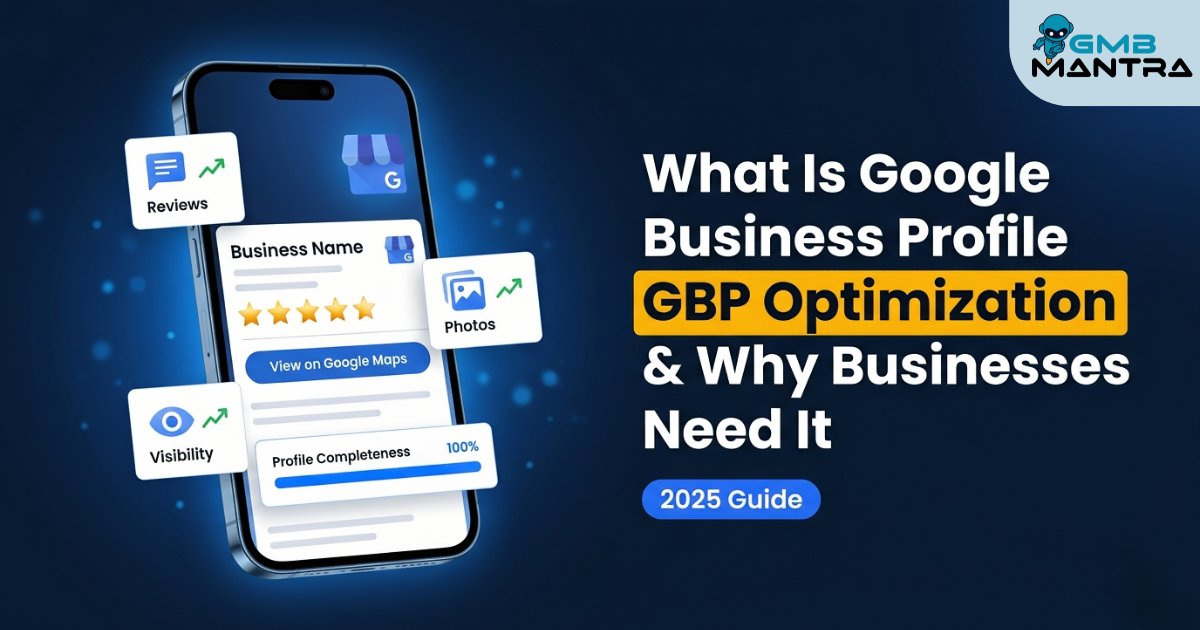
What Is Google Business Profile Optimization & Why Businesses Need It
What Is Google Business Profile Optimization & Why Your Business Can't Afford to Ignore It
I still remember the day a client called me, frustrated. "We're on Google Maps," he said, "but when people search for us, three competitors show up first. What's the point of even having a profile?"
That conversation happened more times than I can count. Here's the thing: having a Google Business Profile isn't the same as having an optimized one. It's like owning a storefront on the busiest street in town but keeping the lights off and the sign turned backward. You're technically there, but you're invisible where it matters most—in the local pack, those top three map results that capture over 60% of all local search clicks.
By the end of this guide, you'll know exactly how to audit, optimize, and maintain your Google Business Profile to dominate local search results and drive measurable customer actions—not just profile views.
Before You Start: The Pre-Flight Check
Don't touch your GBP dashboard until you can answer this: What specific action do I want customers to take when they find my profile?
If you can't articulate whether you need more calls, direction requests, or website visits, stop. Optimization without a goal is just busywork. You'll also need access to your GBP dashboard (obviously), your exact business NAP (Name, Address, Phone) as it appears on your website, and at least 20 high-quality photos with geotags if you're serious about proximity signals.
The Stop/Go Test: Can you log into your GBP Insights right now and tell me your top three search queries from last week? If not, you're not ready to optimize—you're guessing.
The Core Optimization Framework: What Actually Moves the Needle
Phase 1: The Profile Audit (Your Foundation)
Start by searching for your business in incognito mode from three different locations within your service area. What you're looking for: Are you in the top three map results? If you're buried below the fold or, worse, not showing up at all, your category optimization is probably wrong.
The Steps:
- Open your GBP dashboard and navigate to the "Info" section
- Check your primary category—this is the single most important ranking factor. It should be hyper-specific, not generic. "Italian Restaurant" beats "Restaurant" every time
- Verify your NAP matches your website exactly—down to "Street" vs "St." inconsistencies
- Scroll through your attributes and services sections. Empty fields are missed ranking opportunities
Visual Checkpoint: You should see a green "Verified" badge next to your business name. Your primary category should appear directly under your business name in search results. If you see "Permanently closed" or any warning flags, pause and resolve those first—suspension risk is real and devastating.
The Verification: Pull up your GBP listing on Google Maps mobile. Do the "Call" and "Directions" buttons appear prominently? If they're buried or missing, your profile isn't fully activated. Check your Insights—if your action metrics (calls, direction requests, website clicks) are less than 20% of your total views, your profile isn't optimized for conversion.
Expert Nuance: Here's what most guides won't tell you: Google's algorithm prioritizes profiles that demonstrate ongoing activity. A perfectly optimized profile that hasn't been touched in six months will lose ground to a competitor posting weekly updates. This is where GMBMantra becomes invaluable—automated post scheduling and review response keep your profile algorithmically "alive" without manual daily work.
Phase 2: Visual Authority (Photos That Convert)
Most businesses upload 5-10 photos and call it done. That's a mistake. Profiles with 50+ photos receive 42% more direction requests than those with fewer images. But here's the catch: it's not just quantity.
The Steps:
- Organize photos into categories: exterior, interior, products/services, team, and "action shots" of customers using your service
- Geotag every photo before uploading (use a tool like Geotag Photos Pro)
- Upload in batches of 5-7 photos weekly—bulk uploads can trigger spam filters
- Name your files descriptively before upload: "plumber-fixing-leak-brooklyn.jpg" not "IMG\_4738.jpg"
Visual Checkpoint: After uploading, search for your business. Your photo carousel should appear in the knowledge panel with a "View all" option. Click through—do your photos appear before customer-uploaded images? If customer photos dominate, you haven't uploaded enough.
The Verification: Check your GBP Insights under "Photos." Compare your views to competitors in your category. If you're below the median, add more visual content immediately.
The Reality: Low-resolution photos kill click-through rates. I've seen profiles tank because the owner uploaded phone photos from 2015. Google's algorithm can detect image quality. Use at least 720p resolution, and for the love of local SEO, avoid stock photos—they scream "generic" to both users and algorithms.
Phase 3: Content Cadence (Posts & Updates)
Google Posts are the most underutilized feature in local SEO. They're essentially free micro-ads that appear directly in your knowledge panel, yet 70% of businesses never use them.
The Steps:
- Create a post schedule: minimum bi-weekly, ideally weekly
- Structure each post: compelling headline (under 58 characters), 100-150 word description with a clear CTA, and a trackable UTM link
- Use post types strategically: Offers for promotions, Updates for news, Events for time-sensitive content
- Include a call-to-action button (Book, Order, Learn More) that links to a specific landing page
Visual Checkpoint: Your posts should appear in the "Updates" section of your knowledge panel. They display for seven days (or until the event date), then archive. If you don't see your latest post within 24 hours of publishing, republish with different text—occasionally Google flags posts as spam if they're too promotional.
The Verification: After two weeks of consistent posting, check your Insights. Are website clicks increasing? If not, your CTAs are weak or your links are broken. Test every link in incognito mode before publishing.
Expert Nuance: The algorithm rewards velocity, not just volume. Five posts in one day followed by silence for a month is worse than one post every week. Consistency signals business legitimacy. This is exactly why tools like GMBMantra exist—automated post scheduling maintains that critical review velocity without you remembering to log in every Tuesday.
Phase 4: Review Architecture (The Trust Layer)
Reviews aren't just social proof—they're ranking signals. Google's algorithm considers both quantity and recency. A business with 100 reviews from 2019 ranks below one with 30 reviews from the past three months.
The Steps:
- Create a review acquisition system: email follow-ups, QR codes on receipts, SMS campaigns
- Target 5-10 new reviews monthly—this is the sweet spot for review velocity without triggering spam filters
- Respond to every review within 48 hours, even the one-liners. Generic responses are fine; silence is fatal
- For negative reviews, respond publicly with empathy and a solution, then take the conversation offline
Visual Checkpoint: Your average star rating should display prominently in your knowledge panel. If it's below 4.0, you have a reputation problem that optimization alone can't fix. Address service issues first.
The Verification: Check your Insights under "Customer Actions." Are customers clicking your phone number or directions after reading reviews? If not, your responses might be too defensive or robotic. Rewrite them with personality.
The Ghost Error: Ever wonder why some reviews disappear? Google's spam filter is aggressive. If you ask for reviews via the same IP address, if multiple reviews use similar phrasing, or if you incentivize reviews, Google will suppress them. The fix? Diversify your ask. Use different channels (email, SMS, in-person) and never, ever offer discounts for reviews.
> Automate the Tedious Stuff > Managing reviews manually across multiple locations is exhausting. GMBMantra uses sentiment analysis to generate personalized responses instantly, maintaining that critical response rate without the burnout. See how GMBMantra handles review automation
The Ugly Truth: What Breaks (And How to Fix It)
The Suspension Spiral
Twenty to thirty percent of multi-location businesses experience at least one suspension annually. The triggers? Rapid-fire edits, keyword-stuffed descriptions, or NAP consistency mismatches across the web.
The Weird Fix: If you're suspended, delete all recent assets (photos, posts), submit a soft appeal through the enterprise support form, then don't touch the profile for 14 days. I know it's counterintuitive, but Google's algorithm interprets edits during review as manipulation attempts.
The Invisible Profile Problem
You've optimized everything, but you're still not in the map pack. Root cause? Your competitors have more complete profiles. Google prioritizes completeness.
The Weird Fix: Audit the top three competitors in your category. Note every attribute they've enabled—wheelchair accessibility, outdoor seating, LGBTQ+ friendly. Mirror those attributes exactly, even if they seem irrelevant. Google's algorithm weights profile completeness heavily for AI eligibility in Search Generative Experience.
The Action Metric Flatline
Your profile gets views, but nobody clicks your phone number or website. This isn't an optimization problem—it's a conversion problem.
The Weird Fix: Embed trackable UTM links in your posts and description. Use a forwarding number to track calls. Most businesses discover their "Book Now" button links to a broken page or a form that doesn't work on mobile. Test everything incognito, on mobile, from outside your office network.
Why This Matters More in 2026
Google's Search Generative Experience (SGE) and AI Overviews are fundamentally changing local search. Incomplete profiles are being excluded from AI-generated recommendations entirely. The businesses that maintain structured data, complete service lists, and consistent posting are the ones feeding Google's recommendation algorithms.
This isn't speculation—early data shows profiles with incomplete attributes experience 50%+ visibility drops in SGE results. The bar for "optimized" just got higher, and manual management is becoming unsustainable for businesses with limited resources.
Your Next 48 Hours
Don't try to optimize everything at once. Start with the audit. Log into your GBP dashboard right now and verify your NAP, primary category, and Insights data. If those three elements aren't dialed in, nothing else matters.
Then commit to a weekly post schedule. Just one post, every week, for 90 days. Track your action metrics monthly. That's the baseline for local pack stability.
The businesses that win local search in 2026 aren't the ones with the biggest budgets—they're the ones with the most consistent optimization systems. Whether you handle it manually or automate it with platforms like GMBMantra, the key is treating your GBP like the 24/7 customer acquisition machine it actually is.
FAQ: The Implementation Questions
How long does it take to see results from GBP optimization? Initial visibility improvements typically appear within 1-2 weeks of completing a full audit and optimization. Full local pack stability takes 4-6 weeks with consistent weekly posts and review acquisition. If you're not seeing movement after 30 days, your category or NAP likely has issues.
Why did my profile get suspended without warning? Google's spam filters trigger on rapid changes, keyword stuffing in descriptions, or NAP mismatches across aggregators. Submit a soft appeal with proof of business legitimacy, then pause all edits for 7-14 days before retrying.
Can I optimize for multiple service areas? If you're a Service Area Business (SAB), hide your address and use radius optimization. For multiple physical locations, each needs its own unique profile with distinct categories and content—never duplicate descriptions.
How do I track ROI from my GBP? Use UTM parameters in all links, enable call tracking with forwarding numbers, and monitor GBP Insights weekly. Compare direction requests, calls, and website clicks month-over-month. If actions aren't increasing, your optimization isn't conversion-focused.
What's the biggest mistake businesses make with GBP? Treating it like a "set it and forget it" directory listing. The algorithm rewards ongoing activity—posts, review responses, photo uploads. A stale profile loses ground to active competitors, regardless of initial optimization quality.