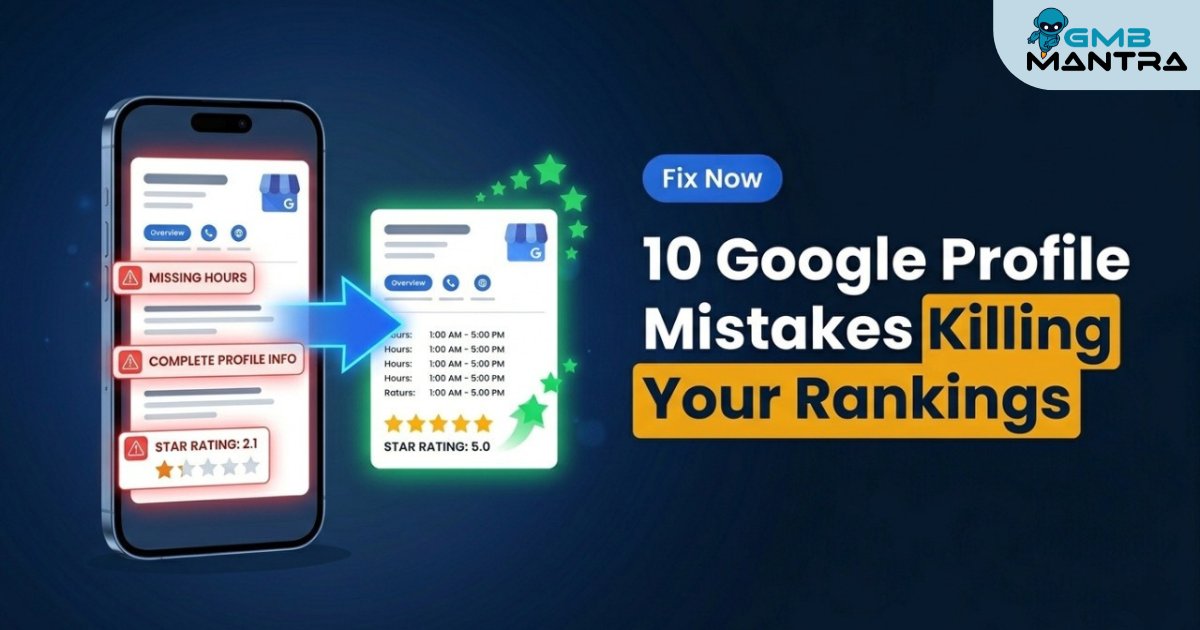
10 Google Profile Mistakes Killing Your Rankings (Fix Now)
10 Google Business Profile Mistakes That Are Quietly Destroying Your Local Rankings in 2026
Let me be blunt: most Google Business Profile optimization advice floating around right now is either recycled from 2022 or so surface-level it's practically useless. I've spent the better part of this year auditing profiles for businesses that thought they'd done everything right, and the patterns I keep seeing are almost always the same ten mistakes.
Here's what's actually tanking local rankings in 2026, and more importantly, how to fix each one without losing your mind.
What Are the Fastest-Triggering GBP Penalties in 2026?
Inconsistent NAP (Name, Address, Phone) information now triggers penalties faster than ever.
Keyword-stuffed business names like "Best Plumber in Pune" face stricter enforcement.
Missing or outdated holiday hours can harm visibility 30+ days before the holiday.
Stock photos and inactive profiles with no posts in 30 days also signal low trust to Google's algorithm.
That answer string covers the highlights, but the details below are where the real damage, and the real fixes live.
Mistake #1: NAP Inconsistencies You Don't Even Know Exist
NAP consistency isn't new advice. But here's what's changed: Google's entity reconciliation in 2026 is aggressive. A mismatched phone number between your GBP and a random Just Dial listing you forgot about three years ago? That used to cause a slow drag. Now it's a faster penalty trigger.
The fix isn't just "audit your listings." It's running a crawl across every directory: Yellow Pages India, Apple Maps, Google reviews, OLX , TradeIndia, and matching everything character-for-character. I'm talking addresses, phone numbers, abbreviations (St. vs. Street), even area code formatting.
Tactile cue: After updating, search your exact business name in quotes on Google. If you see conflicting addresses in the knowledge panel "Also found at" section, you've still got a problem.
Mistake #2: Choosing Categories Like It Doesn't Matter
Primary vs. secondary categories aren't just a dropdown menu. They're a relevant signal that directly shapes which local queries you show up for. I've seen businesses list "Restaurant" as primary and "Car Wash" as secondary. That kind of mismatch now actively hurts relevance scoring.
Pick your primary category based on what you want to rank for most. Secondary categories should be tightly related. If you're a family dentist, "Cosmetic Dentist" as secondary makes sense. "Medical Spa" does not. This helps in GBP optimization.
(I know, it sounds obvious. But I've audited over 200 profiles this year and roughly one-third had category mismatches.)
Mistake #3: Letting Your Photos Get Flagged by Vision AI
This one's a 2026 wake-up call. Google's Vision AI categorization now reads your uploaded images to auto-categorize services. That means a plumber uploading a stock photo of a sparkling kitchen sink gets less ranking benefit than one uploading a slightly blurry photo of an actual pipe repair.
The algorithm can tell. Stock photos are being flagged, and profiles using real images, even mediocre ones, outperform polished but generic imagery consistently.
What to upload: 5–10 high-quality real photos. Exterior, interior, team at work, finished projects. And here's the ghost error nobody talks about: if you upload 50+ images in a batch, Google's photo consistency scoring can actually de-prioritize them. Upload in batches of 5–8 over several weeks.
Weird fix from the forums: One business owner reported that removing all stock photos and re-uploading only authentic images caused a ranking jump within 11 days. No other changes. Just the photos.
Mistake #4: Writing Descriptions That Sound Like a Robot Wrote Them
Here's the tension: every guide says "incorporate keywords naturally." But most businesses end up writing stiff, keyword-optimized descriptions that fail both the SEO test and the customer trust test.
In 2026, chunked service descriptions win. Short, declarative sentences, not dense paragraphs, that are easy for Gemini and AI summaries to parse and repeat back in search results. Think about it: your GBP description IS your answer in AI Overviews now. If it reads like a keyword salad, the AI will skip you for a competitor whose language sounds human.
Write like you're explaining your business to someone at a neighborhood event. Then add Local Business schema markup to handle the technical SEO side.
Mistake #5: Keyword Stuffing Your Business Name
Google's 2026 enforcement is stricter than ever. Business names like "Rahul’s Plumbing | Best Plumber in Pune | 24/7 Emergency Plumber" are getting flagged and penalized faster. Use your legal business name. Period.
If you want SEO juice from your name field, the play is schema markup and a well-optimized description not cramming keywords where they don't belong.
Mistake #6: Ignoring Reviews (or Responding Like a Template)
Review sentiment signals in 2026 go beyond star ratings. Google now weighs volume, sentiment analysis, and response speed as trust indicators. A business with 200 reviews and zero owner responses ranks lower than one with 80 reviews and thoughtful replies to each.
And "Thank you for your feedback!" doesn't count as thoughtful.
Respond within 24 hours. Reference something specific the customer mentioned. For negative reviews, acknowledge the issue without getting defensive. This isn't just reputation management, it's a ranking factor.
>Spending hours managing review responses manually?
> GMBMantra google reviews management uses AI-powered sentiment analysis to generate personalized, on-brand replies instantly—so your response speed stays under 24 hours without the burnout. Think of it as the expert's shortcut for turning review management into a ranking advantage.
Mistake #7: Going Dark on Google Posts
Google Posts with a 30-day cadence are now a baseline expectation, not a bonus. Profiles that haven't posted in 30+ days signal inactivity, and the algorithm treats that as low trust.
Post updates, offers, events, anything that shows the lights are on. Schedule them if you have to. But don't let your profile go stale.
Mistake #8: Forgetting Holiday Hours (Way Too Late)
Most businesses update holiday hours the week of the holiday. That's too late. The ghost error here: GBP penalties for outdated hours can trigger 30+ days in advance. If you know Diwali hours are different, update them in October.
Tactile cue: Set a quarterly calendar reminder to pre-load the next season's special hours. If the "Confirm hours" banner disappears from your dashboard, you're good.
Mistake #9: Skipping Voice Search Optimization
Over 65% of mobile searches are voice-initiated now. That means your business description and Q&A section need conversational language not stiff keyword phrases. Voice search optimization isn't a separate strategy anymore; it's baked into how you write everything on your profile.
Use natural questions and answers. Pair that with Local Business schema markup so Gemini and voice assistants can parse your data correctly.
Mistake #10: No UTM Tracking on Your Website Link
For those of who don’t know, here is what it means Urchin Tracking Module- a URL tagging system used to track marketing performance in analytics tools. If you're not using UTM parameter tracking on your GBP website link, you have zero visibility into how much traffic your profile actually drives. This isn't a ranking factor per se, but it's a strategic blind spot. You can't improve Google Maps ranking if you can't measure what's working.
Set up UTM parameters. Check your analytics monthly. Adjust your local SEO strategy based on real data, not guesses.
FAQs
How do I fix NAP inconsistencies across Google Business Profile and other directories?
Run a full audit using a citation management tool. Match every field: name, address, phone, website, character-for-character across Google, Reddit, Google Maps, Just dial, and niche directories. Fix mismatches at the source, then re-verify on GBP.
What's the difference between a primary and secondary category, and how do I choose?
Your primary category determines your main ranking queries. Secondary categories expand visibility for related services. Choose your primary based on your highest-revenue service, and keep secondaries tightly relevant with no mismatches.
How often should I post on Google Business Profile to stay visible?
At minimum, every 30 days. Weekly is better. Use a mix of updates, offers, and event posts to signal activity. GMBmantra manages local seo services which can bring in additional revenue.
Why are my Google Business Profile photos not showing up in search results?
Common causes: stock photos flagged by Vision AI, batch uploads being deprioritized, or low-resolution images. Upload authentic, high-definition photos in small batches over time.
How do I respond to negative reviews without making things worse?
Acknowledge the specific issue, apologize without being defensive, and offer to resolve it offline. Never copy-paste the same response across multiple reviews, Google's sentiment analysis catches that.
How do I optimize my GBP for voice search?
Write your description and Q&A answers in conversational, question-and-answer format. Add LocalBusiness schema to your website so voice assistants can pull structured data.
Can I track how much traffic my Google Business Profile sends to my website?
Yes. Add UTM parameters to your GBP website link and monitor the traffic in Google Analytics under campaign tracking.
Final Takeaway
Your GBP isn't a "set it and forget it" listing anymore: it's a living, breathing ranking asset. If even two or three of these mistakes apply to you, fixing them is probably the highest-ROI move you'll make this quarter.
Need a faster way to manage all of this from one place? GMBMantra handles profile optimization, post scheduling, and review responses so you can stop firefighting and start ranking.