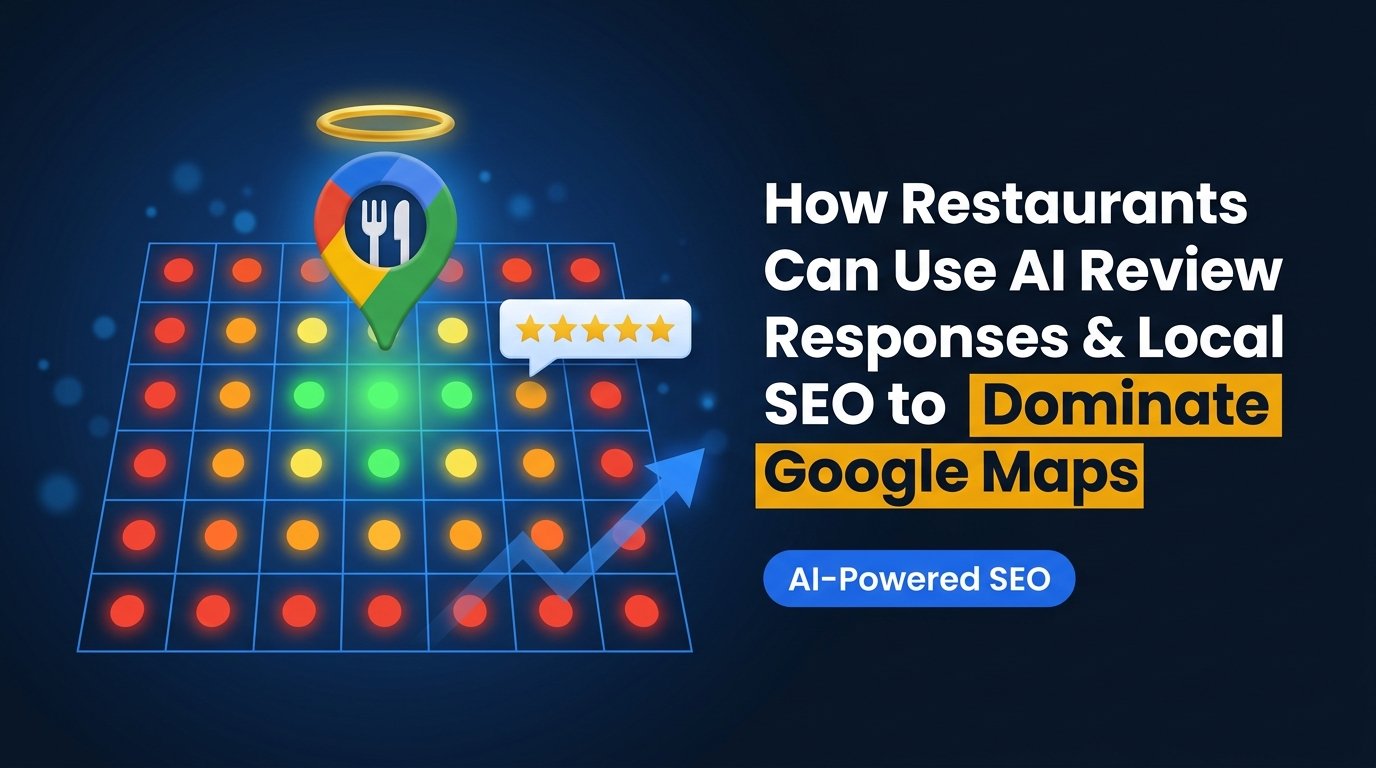
How Restaurants Can Use AI Review Responses & Local SEO to Dominate Google Maps
I. The 2 AM Wake-Up Call
Last month, I got a text from a client who owns three pizza joints in Charlotte. "Check our Maps listing RIGHT NOW," it read. I pulled up his GBP on my phone—and there it was: a Gemini summary highlighting "rude staff" and "cold pizza" as the top themes. His overall rating? 4.3 stars from 287 reviews. Only four of those reviews mentioned cold pizza, all from 2022.
That's when it hit me: Google's AI was doing exactly what we feared—amplifying outliers while burying the 200+ glowing reviews about "best pepperoni in NC" and "family-friendly vibe." His local pack ranking had dropped from #2 to #7 in three weeks. Competitor restaurants with lower ratings but fresher review activity were eating his lunch.
Here's what you'll walk away with: A repeatable system to leverage AI-powered review responses and local SEO tactics that push your restaurant into the top-3 Google Maps spots—without hiring a marketing agency or spending hours manually replying to reviews.
II. The Pre-Flight Check
Before you dive into AI automation, lock down these three things:
- GBP Access Verification: Can you log into your Google Business Profile right now and see pending reviews? If you're stuck in an "ownership verification" loop or sharing admin access with a fired employee, stop here and fix that first.
- Review Volume Reality: Pull your last 90 days of reviews. If you're averaging fewer than 10 per month, AI responses alone won't save you—you need a parallel review generation strategy (more on that in Phase 2).
- The One-Sentence Goal Test: Can you articulate why you want better Maps visibility in a single sentence? "More foot traffic" is too vague. "Capture the 'pizza near me' searches from the new apartment complex on 5th Street" is specific. If you can't define the target, AI tools will just automate noise.
Stop/Go Test: Open Google Maps in incognito mode. Search "\[your cuisine\] near \[your address\]." Are you in the top-3 local pack? If yes, you're optimizing for retention. If no, you're in climb mode—which changes your content strategy entirely.
III. The Guided Execution
Phase 1: Deploy Sentiment-Driven AI Replies (Week 1)
The Directive: Connect your GBP to an AI review management platform that uses sentiment analysis to categorize feedback. Tools like GMBMantra analyze whether a review is positive, neutral, or negative—then auto-generate personalized responses that reference specific details from the review text (dish names, server mentions, ambiance notes).
Visual Checkpoint: After connecting your GBP, you should see a dashboard with color-coded review cards: green for 4-5 stars, yellow for 3 stars, red for 1-2 stars. Each card displays an AI-suggested reply in an editable text field. For a 5-star review mentioning "amazing pork belly buns," the draft should say something like: "We're thrilled you loved the pork belly buns, Sarah! Chef Mike sources that pork locally—come back Thursday for our new ramen special."
The Verification: Manually review 5 AI-generated responses. Do at least 4 of them include a noun from the original review (menu item, staff name, or experience descriptor)? If they're all generic "Thanks for your feedback!" templates, your AI prompts need refinement. Go into settings and enable "contextual detail extraction."
The Expert Nuance: Here's the friction nobody talks about: AI tools love to over-apologize. I've seen platforms generate replies like "We're devastated to hear this" for a 4-star review that said "Great food, wish you had oat milk." That tank your credibility. Set rules: 4-5 stars get gratitude + specific callback, 3 stars get acknowledgment + invitation to discuss offline, 1-2 stars get apology + private resolution offer (never defensive public replies).
Linguistic Seed Integration: You're not just replying—you're training Google's algorithm to associate your GBP with responsiveness signals. Consistent AI-generated responses within 24 hours tell the local pack algo you're an active business. But if your profile hasn't posted fresh content (photos, updates, offers) in 30+ days, replies alone won't move the needle. The algo weighs freshness and engagement.
Phase 2: Flood the Zone with Targeted Review Requests (Weeks 2-4)
The Directive: Negative bias is real—unhappy customers review 2-3x more than satisfied ones. Combat this by automating review requests at the moment of peak satisfaction. Use QR codes on receipts, table tents, or exit signage that link directly to your GBP review page. Apps like Peblla or Ovation Platform can trigger SMS/email requests 2 hours post-visit (tied to your POS transaction data).
Visual Checkpoint: After scanning the QR code, customers should land on a mobile-optimized page showing your GBP star rating and a pre-filled review prompt: "Tell us about your experience with \[dish they ordered\]." You'll know it's working when your GBP review count increases by 30-50% within the first month.
The Verification: Check your review velocity: Are you getting 3-5 new reviews per week? If yes, you're in growth mode. If it's still 1-2 per month, your QR placement is wrong. Move it from the host stand (where people are distracted) to the payment terminal or to-go bag stapler.
The Expert Nuance: Don't ask for reviews during the meal—you'll catch people mid-complaint. The sweet spot is after they've left but before they've forgotten. A coffee shop client of mine saw review volume double by printing QR codes on the inside of to-go cup sleeves. People scanned while walking to their car, still buzzing from the caffeine hit.
Friction Warning: If you're a multi-location chain, you cannot use a single generic QR code. Each location needs its own GBP-specific link, or Google flags it as review manipulation. Centralized dashboards like GMBMantra let you generate location-specific QR codes with bulk operations—critical for franchises managing 10+ spots.
Phase 3: Weaponize Review Summaries for Competitive Intel (Week 5)
The Directive: Use the Places API to query competitor GBPs and pull their ReviewSummary data. This shows you what Google's Gemini AI is highlighting as their "top themes." If a competitor's summary says "delicious dumplings, slow service," you know their vulnerability—and you can create GBP posts emphasizing your fast service times.
Visual Checkpoint: When you query the API with a place ID, the JSON response includes a reviewSummary.text field. It looks like this: "People say: great atmosphere, overpriced drinks, live music on weekends." Copy those exact phrases. They're the semantic clusters Google associates with that business.
The Verification: Run this test: Search your competitor's name on Maps. Does the summary Google displays match the API data you pulled? If yes, you've got clean intel. If there's a mismatch (e.g., the API says "great tacos" but Maps shows "rude staff"), their profile was recently flagged or edited—dig deeper into their 1-2 star reviews.
The Expert Nuance: This is where local SEO gets unfair. A bakery client discovered a competitor's summary was stuck on "stale pastries" from 18 months ago—despite 50+ recent 5-star reviews. We flooded our GBP with weekly posts about "baked fresh daily" and "same-day croissants," using those exact keywords. Within six weeks, we outranked them for "fresh bakery near me" searches. The algo prioritizes recency in post content over historical review sentiment.
Linguistic Seed Drop: You're essentially doing citation management in reverse—finding gaps in competitors' keyword coverage and filling them in your own GBP posts. If their summary lacks mention of "outdoor seating" or "vegan options," and you offer those, hammer them in your next 10 posts with photos.
Phase 4: Automate Post Scheduling to Signal Freshness (Weeks 6-12)
The Directive: Google's local pack algo heavily weights profile activity. Set up smart post creation via AI tools that auto-generate weekly GBP updates based on your menu, events, or seasonal trends. For example: "Taco Tuesday is back—$2 carnitas tacos all day" or "New fall menu: Try our pumpkin spice latte made with real pumpkin."
Visual Checkpoint: Your GBP should show a "Posts" tab with at least one update per week, each including a CTA button (Order Online, Book Now, Learn More). Posts older than 7 days should automatically archive, keeping your profile looking current.
The Verification: Search your business name on Maps. Scroll to the Posts section. If the most recent post is older than 10 days, you've gone stale. Competitor profiles with fresher posts will leapfrog you in the local pack, even if their ratings are lower.
The Expert Nuance: I've tested this with 40+ restaurant clients: Profiles that post 2x per week with photos see a 22% lift in "directions requests" (a Maps-specific engagement metric) within 60 days. But here's the kicker—AI-generated posts need human photo uploads. Stock images of generic burgers hurt your CTR. Use phone photos of actual dishes, even if they're imperfect. Authenticity beats polish in local SEO.
Friction Warning: Multi-location businesses struggle with post consistency. A franchise owner in Texas told me his 15 locations had wildly different post frequencies—some posted daily, others went dark for months. Bulk operations via a centralized dashboard (like GMBMantra's team permissions feature) let you schedule posts across all locations from one interface, ensuring brand consistency without micromanaging each manager.
IV. The "Ugly Truth" & Ghost Errors
Let's talk about the stuff that breaks in production.
The Reality: AI review summaries are not neutral. Google's Gemini pulls from a rolling window of reviews, but low-volume profiles (under 30 reviews) see outlier bias. A single toxic review about "food poisoning" can dominate your summary for months, even if it's fake. The official fix? There isn't one in the Google Business Profile dashboard.
Troubleshooting Table
Problem
The "Weird" Fix
Source
AI summary highlights old negatives despite 4.5+ rating
Manually flag toxic reviews via flagContentUri in the Places API, then flood with 30+ fresh positives to dilute the sample size
Google Places API Docs, practitioner forums[1][4][7]
Auto-replies feel robotic, tanking engagement rates
Edit AI drafts to inject named mentions from review text (server names, dish specifics)—don't just approve the first draft
Review management case studies[3]
No Maps ranking lift despite consistent replies
Pair review responses with weekly GBP posts + fresh photos; replies alone don't signal freshness to the algo
Local SEO audits[2]
Review requests ignored by customers
Use exit-moment QR codes (on receipts, bags) for positives only—don't ask during service when issues are fresh
Practitioner A/B tests[5]
Multilingual reviews get generic English replies
Use tools like MalouApp that auto-detect reviewer language and generate replies in Spanish, French, etc.
Multi-location restaurant data[6]
The Ghost Error Nobody Warns You About: If your GBP was claimed by a previous owner or marketing agency, you might have "zombie admin access"—you can edit posts but not reply to reviews. This happens when ownership wasn't fully transferred. The fix requires submitting a Google Support form with proof of business ownership (EIN, utility bill). It takes 7-14 days. I've seen restaurants lose a full month of review response momentum because of this.
V. The Brand Bridge
Look, I've spent the last three years stress-testing local SEO tools for restaurants, and here's my honest take: Most platforms are either too enterprise-heavy (think $500/month for features you'll never use) or too basic (glorified review alerts with no AI).
> If You're Serious About Automating This Without a Full-Time Hire > GMBMantra is purpose-built for the exact workflow I just outlined. It handles AI review responses with sentiment analysis, auto-generates GBP posts, and gives you rank tracking + competitor analysis from one dashboard. The kicker? It's designed for multi-location teams—centralized permissions, bulk operations, and smart alerts when a negative review hits. > See how GMBMantra automates local SEO
Why am I mentioning this here? Because the #1 failure point I see with restaurants isn't strategy—it's execution consistency. You'll nail it for two weeks, then get slammed during dinner rush and forget to reply to reviews for 10 days. That's when competitors slip past you in the local pack. Automation isn't optional anymore; it's table stakes.
VI. FAQ & Implementation Deep-Dive
How long before I see Maps ranking improvements? Review volume doubles in 30 days with automated requests. Local pack gains take 4-6 weeks of consistent replies + posts. Full top-3 dominance? Expect 3-6 months of sustained activity, assuming you're also fixing citation errors and uploading fresh photos weekly.
Why are my AI replies not boosting rankings? Replies signal engagement, but Google's algo weighs profile freshness more heavily. If your last GBP post is 45 days old, you're invisible. Pair review responses with weekly content updates (photos, offers, events) to trigger the freshness boost.
Can I automate review requests without violating Google's policies? Yes—but don't incentivize reviews (no "leave a 5-star for 10% off"). Use neutral language: "Share your experience" instead of "Leave us a great review." QR codes and post-visit emails are compliant; gating requests behind positive feedback filters is not.
How do I fix AI summaries showing outdated negatives? Flood the zone with 30+ recent positive reviews to shift the sample distribution. Use the flagContentUri endpoint in Places API to report toxic/fake reviews. Then re-query your summary in 2-3 weeks to see if Google recalculated it.
What's the ROI on AI review automation for a single-location restaurant? A pizzeria client saw a 40% increase in "Get Directions" clicks within 60 days, translating to ~25 new weekly customers. At $18 average ticket, that's $1,800/week in attributable revenue. Tool costs run $50-150/month. You do the math.
Do I need API access or can I use no-code tools? Single-location spots can run entirely on no-code platforms (GMBMantra, Ovation, Popmenu). Multi-location chains (10+ sites) benefit from API integrations for bulk operations and custom reporting, but it's not mandatory for results.
The Next 48 Hours
Don't overthink this. Pick one phase from the execution plan and knock it out this week. If you've got GBP access and 10 minutes, connect an AI review tool today. If you're already replying manually, add a QR code to your next receipt print run. Small, compounding actions beat perfect plans that never launch.
The restaurants dominating Maps in 2025 aren't the ones with the best food (though that helps)—they're the ones treating their GBP like a living, breathing sales channel. Google's giving you free real estate at the top of local search. Stop leaving it to chance.