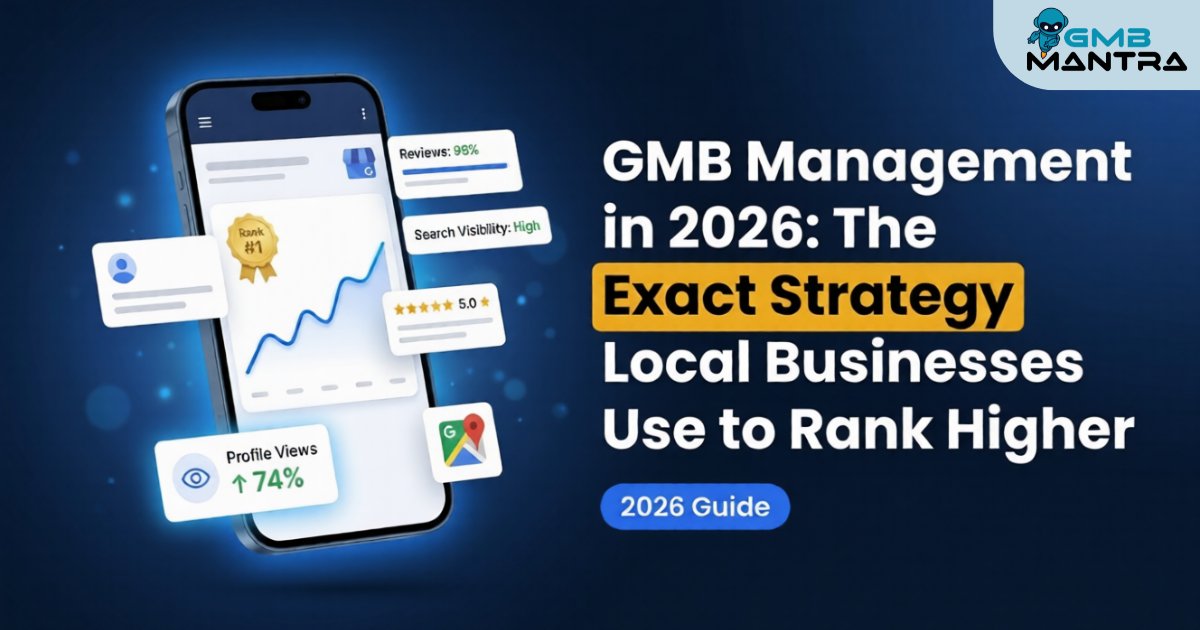
GMB Management in 2026: The Exact Strategy Local Businesses Use to Rank Higher
Last month, I watched a client's GBP vanish from the Local Pack overnight. No warning email. No suspension notice. Just... gone. Three years of reviews, posts, and careful optimization—invisible. We spent 72 hours diagnosing the issue before discovering a single NAP mismatch on an obscure directory we'd forgotten existed. One wrong phone number on a listing nobody visits tanked everything.
That experience rewired how I approach GMB management entirely.
By the end of this guide, you'll have the exact phase-by-phase strategy to optimize, verify, and protect your Google Business Profile so it ranks higher in 2026—and stays there.
Before You Touch Anything: The Pre-Flight Check
Here's your Stop/Go test: Can you log into your GBP dashboard right now and confirm every single field is filled with current, accurate information?
If the answer is no, don't skip ahead. You need these locked down first:
- Access to your GBP Dashboard with owner-level permissions
- A NAP spreadsheet documenting your business name, address, and phone across every directory you've ever listed on
- A smartphone capable of recording video verification footage
- A citation audit tool like Whitespark
- Your Insights Dashboard pulled up with last 90 days of data visible
That last one matters more than people think. I've seen businesses pour effort into optimization while their Insights show less than 80% profile completeness. You're building on sand at that point.
Phase 1: Lock Down Your Foundation
What to do: Open your GBP Dashboard and audit every field. Business name, address, phone, hours, services, products, attributes—all of it. Cross-reference against your NAP spreadsheet.
Here's where most guides gloss over the friction: inconsistent NAP data across 50+ directories drops rankings by roughly 25%. Not "might affect" your rankings. Drops them.
Run a full citation audit. Every directory. Every aggregator. I know it's tedious. I spent an entire afternoon last quarter fixing listings on directories I didn't even remember creating. But even one mismatch can trigger what practitioners call a ghost ban—your profile just quietly disappears from local results.
Visual Checkpoint: When your foundation is solid, you'll see green checkmarks across all profile sections in your GBP Dashboard. If any section shows incomplete, you're not done.
Verification: Search your business name in an incognito Maps session. Your pin should land within 50 meters of your actual location, and your NAP should match exactly what's on your website.
The proximity signal is everything for mobile searches in 2026. If your pin is offset or your address data conflicts across platforms, Google simply won't trust your listing enough to surface it.
Phase 2: Category Stack and Keyword Architecture
What to do: Set your primary category to the most specific match for your core service. Then stack up to 9 secondary categories that capture long-tail queries your customers actually use.
Don't guess here. Pull your Insights Dashboard and look at the search queries driving traffic. You'll probably find queries you never expected—and queries you thought were driving traffic that aren't.
Integrate LSI keywords naturally into your business description, services, and posts. "Emergency plumber near me" reads naturally. "Best top-rated emergency plumber services company near me" reads like spam—and Google's 2026 algo treats it that way.
Visual Checkpoint: Your category stack should show your primary category plus relevant secondaries in the dashboard. In Insights, you should start seeing query diversity increase within 2-4 weeks.
Verification: Check if your profile appears for 3 different long-tail variations of your service in incognito search. If it only shows for your brand name, your category stack needs work.
> Struggling to track which keywords actually move the needle? > GMBMantra's keyword heatmaps show exactly which search terms drive views versus conversions—so you stop guessing and start optimizing what matters.
Phase 3: Review Velocity and Response Strategy
This is where I see the biggest gap between businesses that rank and businesses that don't.
The data is pretty clear: every 10 new reviews boost local rankings by 20-30%. But here's the nuance nobody talks about—it's not just volume. It's review velocity. Google wants to see 5-10 authentic reviews landing per week, consistently. A burst of 30 reviews in one week followed by silence for two months actually looks suspicious.
What to do: Build a systematic review generation workflow. Ask after every completed service. Use follow-up emails timed 24-48 hours post-service. And respond to every single review—good and bad—with natural, specific language.
I made the mistake early on of using templated responses. Same "Thank you for your kind words!" copy-pasted across dozens of reviews. That's a signal Google picks up on, and it dilutes the EEAT signals your responses should be building.
Visual Checkpoint: Your dashboard should show a 4.5+ star average with a visibly rising review count. You'll see the review count badge incrementing steadily, not in spikes.
Verification: Manually scan your 10 most recent reviews. Are they spread across the last 2-3 weeks? Are your responses unique and specific to each reviewer's experience? If yes, you're on track.
Phase 4: Posts, Photos, and Video Verification
Schedule GMB Posts weekly. Not monthly. Not "when you remember." Weekly, with clear CTAs—book now, call today, get a quote.
Here's the friction warning: posts without geo-fenced Post Ads often get near-zero engagement. I was looking at the data recently and it's wild that optimized GBPs see 2-3x more leads than incomplete ones, yet most businesses treat posts as an afterthought.
Upload fresh, geotagged photos regularly. And in 2026, video verification isn't optional—it's non-negotiable. Google now requires video proof showing your staffed workspace during business hours, with visible signage. 40% of suspensions in 2026 come from virtual office setups that can't pass this check.
Visual Checkpoint: You should see orange "Action Taken" icons on your posts indicating calls or bookings. Your photos section should show recent uploads with location data embedded.
Verification: Check your last 5 posts for greater than 5% interaction rate. If you're seeing zeros, it's time to layer in Post Ads geo-fenced to your service area.
The Ugly Truth: Ghost Errors That Kill Rankings
Here's the stuff you won't find in Google's official help docs.
| Problem | The Weird Fix | Why It Works |
|---|---|---|
| Profile invisible despite full optimization | Upload 360° video of staffed workspace during business hours | Proves proximity signal for virtual/hybrid addresses |
| Sudden suspension, no warning | Bulk audit and correct 50+ citations using Location Groups | Resolves NAP conflicts triggering automated flags |
| High views but zero clicks | Enable booking buttons + run geo-fenced Post Ads | Bridges the gap between visibility and conversion |
| Reviews not moving rankings | Systematize 5-10 authentic reviews per week with unique replies | Consistent velocity signals freshness to the algorithm |
| Multi-location duplicate flags | Create unique descriptions per location + custom My Maps embeds | Differentiates locations Google otherwise sees as duplicates |
70% of local searches ignore unverified profiles entirely. That number still shocks me. You can do everything else right, and if your verification is incomplete or expired, you're invisible to the majority of searchers.
(I know, that sounds dramatic, but I've watched it happen to three different clients this year alone.)
> Managing reviews across multiple locations gets messy fast. > GMBMantra's AI-powered review response system uses sentiment analysis to generate unique, natural replies—so every response builds EEAT signals instead of looking like a bot wrote it.
FAQ
How long before GMB optimization actually improves rankings?
Expect initial improvements in views and clicks within 2-4 weeks. Significant Local Pack movement takes 3-6 months of consistent posting, review generation, and citation management. Competitive markets sit firmly at the 6-month end—there's no shortcut past that timeline.
Why did my GBP get suspended after a virtual office setup?
Google's 2026 video verification requires proof of a staffed, physical workspace with visible signage during posted business hours. Virtual offices without permanent staff fail this check. Submit a new video verification with your full workspace visible to reinstate.
How do I fix NAP inconsistencies across dozens of directories?
Use a citation management tool to audit 50+ directories systematically. Correct every mismatch—even minor ones like "Street" vs "St." Then monitor via your GBP management dashboard to catch future drift before it triggers ranking drops.
What's the right number of reviews to collect per week?
Aim for 5-10 per week with natural pacing. Sudden spikes look manufactured. Build a consistent review generation workflow tied to your service delivery cycle so reviews land steadily rather than in bursts.
Why do my GMB Posts get zero engagement?
Posts without paid amplification often flatline. Layer geo-fenced Post Ads targeted to your service radius. Add strong CTAs—"Book Now" or "Call Today"—and track which post types drive actual conversions through your Insights Dashboard.
Is managing GMB manually still viable in 2026?
For a single location, maybe. For multi-location businesses using Location Groups, manual management creates the exact inconsistencies that trigger suspension audits. Backlink authority building, post scheduling, and review response at scale demand automated GBP management tools.
---
The businesses winning the Local Pack in 2026 aren't doing anything revolutionary. They're just doing the fundamentals with ruthless consistency—and catching the ghost errors before Google catches them first. So here's your next move: run that Suspension Audit you've been putting off, and fix what you find before it fixes your rankings for you.