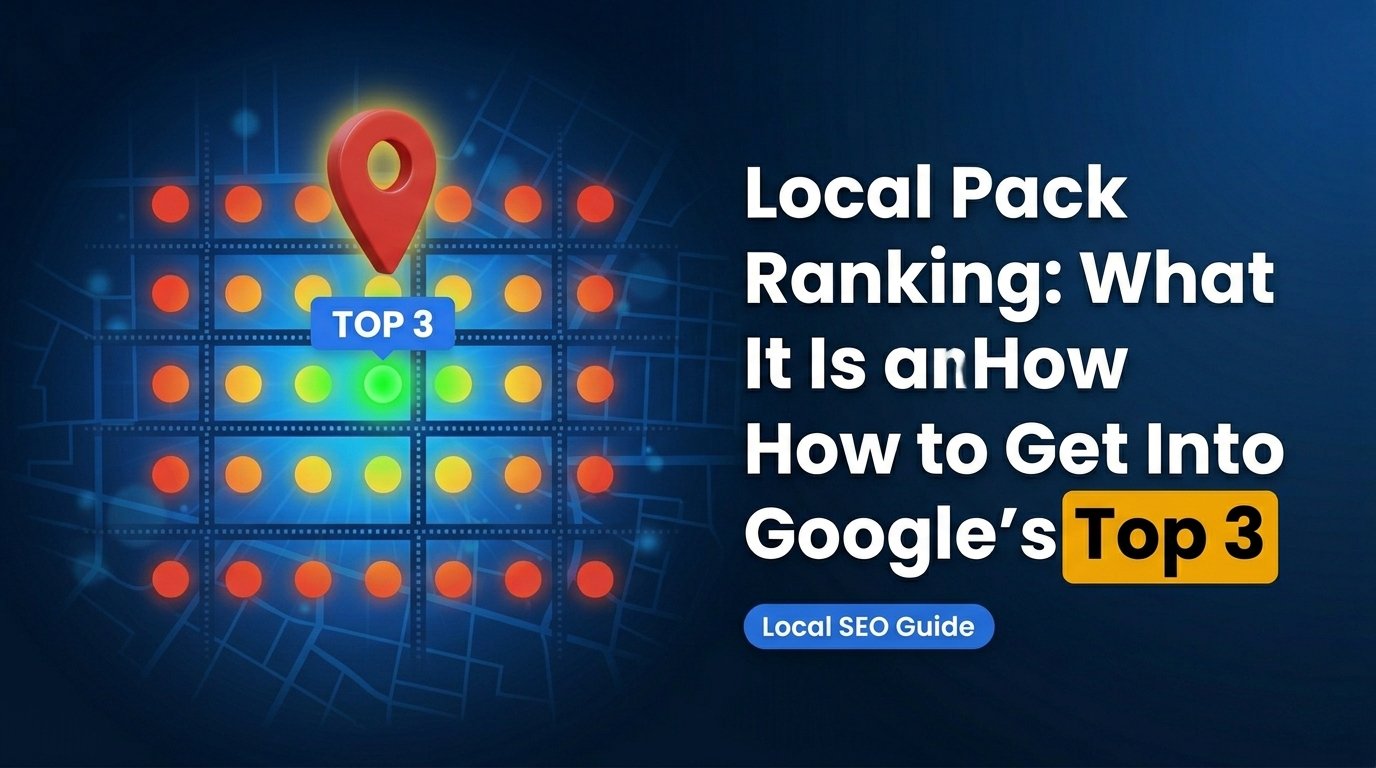
Local Pack Ranking: What It Is and How to Get Into Google's Top 3
I was staring at a client's GBP Insights dashboard last month—calls down 40%, direction requests flatlined—and their profile looked complete. Every field filled, photos uploaded, hours accurate. On paper, they'd done everything right. It took me three hours of manual citation auditing across 50+ directories before I found it: a single phone number digit transposed on Yelp from 2019, silently poisoning their NAP consistency and ghosting them out of the Local Pack entirely.
That's the thing about local pack ranking nobody warns you about. The gap between "optimized" and "actually ranking in Google's top 3 map results" is filled with invisible landmines.
Here's what you'll walk away with: a phase-by-phase system to audit, fix, and climb into the Local Pack—plus the ghost errors that forums talk about but most guides skip.
Before You Start: The Pre-Flight Check
You need four things locked down before any of this matters:
- A verified Google Business Profile (look for the blue "Verified" checkmark in your GBP dashboard)
- Access to rank tracking and citation management tools (BrightLocal, Whitespark, or similar)
- Your exact NAP data documented in one place—business name, address, phone number, character for character
- A competitor analysis baseline—search your primary service + city incognito and screenshot who's currently in the top 3
Stop/Go test: Can you name your primary GBP category and confirm it matches your top-revenue service in one sentence? If not, stop here and fix that first.
Phase 1: <a href="https://gmbmantra.ai/google-business-profile-optimization">Profile Optimization</a> and the GBP Audit
GBP signals carry 32% of Local Pack ranking weight. That's nearly a third of the algorithm riding on your profile alone. So a surface-level profile audit isn't enough—you need a forensic one.
Here's the execution:
- Primary category accuracy. Your primary category must reflect your highest-intent service. A plumber who sets "Home Services" instead of "Plumber" is bleeding relevance. Check competitors in the Pack—what primary category are they using?
- Complete every single attribute. Services, products, business description, accessibility options, payment methods. Google rewards completeness. I've seen profiles jump from position 7 to position 4 just by filling in the service area signals and adding structured services.
- Run a full profile audit. Open your GBP dashboard, click through every section, and look for yellow warning icons or incomplete fields. Your profile completeness should hit \>90% before moving on.
- Photo management matters more than you think. Upload geo-tagged photos of your storefront, team, and work. Google's image recognition feeds entity authority. Aim for 10+ quality photos minimum—refreshed quarterly.
Visual Checkpoint: In your GBP dashboard, every section should show a filled progress indicator. No orange "Add info" prompts remaining.
Verification: Search your business name in incognito. Your Knowledge Panel should display accurate hours, phone, photos, and your primary category. If anything's off, you're not done.
Friction warning: About 30% of GBP edits can trigger soft suspensions if you change your business name or address format. Make edits incrementally, not all at once.
Phase 2: Citation Management and NAP Consistency
This is where most businesses silently bleed rankings. NAP consistency across directories accounts for 6% of Local Pack factors—sounds small until you realize a single mismatch can cascade into a ranking drop.
- Audit your top 50 citations manually or use a tool like Moz Local. Look for abbreviation mismatches ("St" vs "Street"), old phone numbers, and duplicate listings.
- Fix structured citations first—Yelp, Yellow Pages, Facebook, Apple Maps, Bing Places. Then hunt unstructured citations: unlinked brand mentions on blogs, news sites, local directories.
- Submit corrections through data aggregators (Neustar Localeze, Data Axle) to propagate fixes downstream. This takes 2-4 weeks to sync, so don't panic if changes aren't instant.
Visual Checkpoint: Your citation management tool should show green consistency checks across all major directories. Zero red flags.
Verification: Manually Google your business phone number in quotes. Every result should show identical NAP data. If you see old addresses or wrong numbers—you've got more work to do.
> Streamline Your Profile Audit and Citation Fixes If you're managing multiple locations or just want the manual grind automated, GMBMantra's profile audit and optimization dashboard runs this entire check from one screen—flagging inconsistencies, tracking competitor categories, and keeping your GBP data clean without the spreadsheet chaos.
Phase 3: Review Velocity and Behavioral Signals
Reviews carry 20% weight in Local Pack rankings. But here's what most guides get wrong—it's not your total review count that matters. It's review velocity: the pace of new, recent reviews.
Two fresh reviews per month beats 200 stale ones from 2022. Stagnant profiles lose roughly 20% ranking power when velocity flatlines for 60+ days.
The system:
- Build a post-service SMS or email flow asking for reviews within 24 hours of service completion. Keep it simple—direct link to your GBP review page.
- Encourage review keywords naturally. Don't script reviews (that's obvious and risky), but your follow-up message can say: "We'd love to hear about your experience with \[service\] in \[city\]."
- Respond to every review. Positive and negative. This feeds behavioral signals and shows Google active engagement. Use sentiment-aware responses—not copy-paste templates.
- Track clicks to call and direction requests in GBP Insights weekly. These behavioral signals account for 9% of ranking factors and they're your clearest proof of real-world intent.
Visual Checkpoint: GBP Insights should show green upward arrows on calls and direction requests month-over-month. Your review tab should show activity within the last 30 days.
Verification: If weekly calls/directions show \>10% MoM growth and you're getting 2+ reviews monthly with relevant keywords—you're on track.
Phase 4: Hyperlocal Content and Schema Markup
On-page signals contribute 15% to Local Pack rankings, and this is where most local businesses completely drop the ball.
- Build dedicated location pages for each service area. Not thin doorway pages—genuine hyperlocal content referencing neighborhood landmarks, local events, or area-specific service details.
- Deploy LocalBusiness schema markup on every location page. This turns your content into machine-readable data that anchors your GBP in Google's knowledge graph, building entity authority.
- Post scheduling on GBP matters. Regular Google Posts (weekly minimum) signal freshness. Share offers, events, updates—anything that drives engagement back to your profile.
Visual Checkpoint: Run your location pages through Google's Rich Results Test. You should see a green "Valid" badge with no errors or warnings on your schema.
Verification: Search "\[your service\] near \[specific neighborhood\]" incognito on mobile. If your listing appears with a map pin in the top 3 results with visible call/directions buttons—Phase 4 is working.
The Ugly Truth: Ghost Errors That Kill Rankings
Here's the stuff that doesn't make it into Google's official documentation:
Problem | The Weird Fix | Where It's Discussed |
|---|---|---|
Sudden Pack drop after GBP edits | Ghost NAP mismatch from old aggregators—audit 50+ sites manually, force-resubmit via GBP support | |
Reviews not impacting rankings | Zero velocity for 90+ days—seed 2-3 authentic reviews weekly via post-service SMS | |
Can't rank beyond 10-mile radius | Missing service area setup—add explicit service areas in GBP + build hyperlocal pages per zone | |
High impressions but zero conversions | Mobile UX killing behavioral signals—compress images <100KB, monitor call/direction drops |
(I know, some of these "fixes" sound almost too simple. But I've watched businesses spend months on link building while a proximity lockout from missing service areas was the actual blocker.)
> Stop Guessing, Start TrackingGMBMantra gives you rank tracking, competitor analysis, post scheduling, and photo management in one dashboard—with keyword heatmaps that show exactly where your Local Pack visibility is strong and where it's dropping. It's the tool I recommend when manual auditing stops scaling.
How Long Does Local Pack Ranking Take?
Initial GBP optimizations show movement in 2-4 weeks. Full top-3 stabilization—with consistent review velocity, behavioral signals, and hyperlocal content compounding—typically takes 3-6 months. There's no shortcut past proximity and consistency.
Why Is My Local Pack Ranking Dropping After Getting New Reviews?
Check for velocity gaps between review bursts. Google flags unnatural patterns. Ensure reviews contain varied keywords and come from accounts with history—not freshly created profiles. Resubmit your GBP for re-indexing if drops persist beyond two weeks.
How Do I Fix NAP Inconsistencies Across Dozens of Directories?
Start with the four major data aggregators to cascade corrections. Then manually claim and update your top 20 citation sources. Use a citation management platform to monitor ongoing consistency—because aggregator sync delays mean old data resurfaces for weeks.
Can Service-Area Businesses Rank in the Local Pack Without a Storefront?
Yes, but you must define explicit service area signals in GBP and build hyperlocal pages for each zone. Test your visibility with incognito VPN searches from different locations within your service radius. Without this, proximity caps your reach at 5-10 miles.
So—where's your biggest gap right now? If you haven't run a proper citation audit in the last 90 days, that's probably your answer. Start there, get the NAP clean, and everything else compounds faster than you'd expect.