What is LocalBusiness Schema and How Does It Help Your GBP Rank Higher?
I spent three weeks troubleshooting why a client's dental practice wasn't showing up in the local pack—despite having a fully optimized Google Business Profile, 200+ reviews, and solid citation management across every directory that mattered. The rank tracking data looked fine on paper. Competitor analysis showed we were ahead on every traditional signal. Then I found it: a single character mismatch between the street address in their website's JSON-LD markup and their GBP listing. "Suite 4B" on the site. "Ste 4B" on Google. That tiny discrepancy was ghosting their rich snippets entirely.
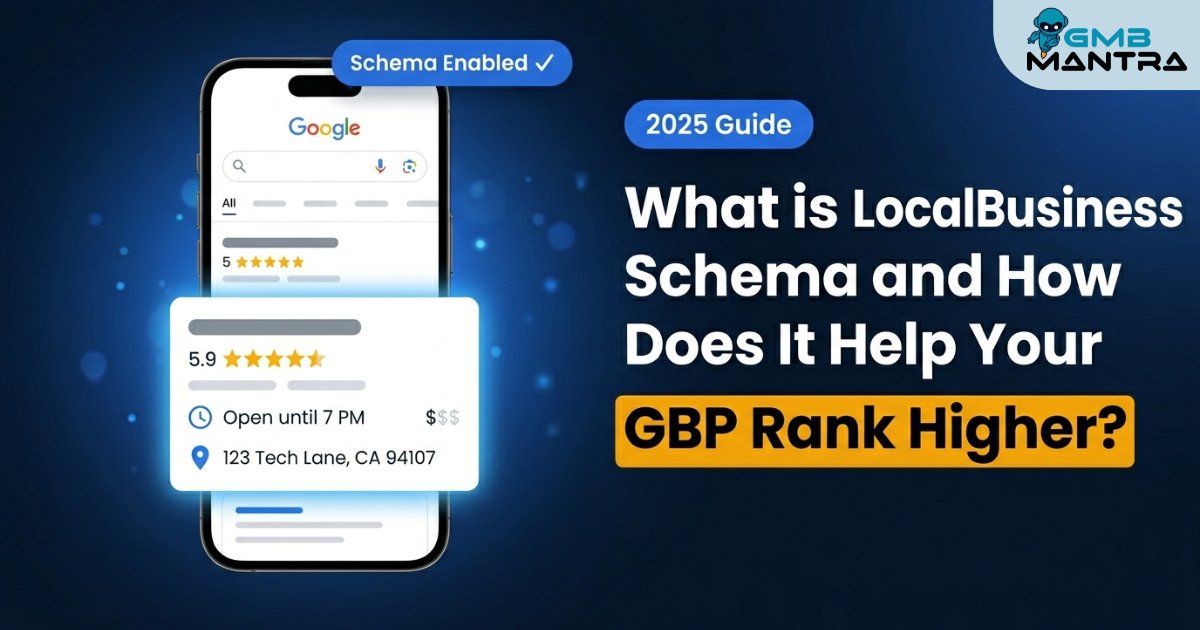
LocalBusiness schema is the structured data bridge between your website and Google's understanding of your business entity—and when it breaks, it breaks silently.
By the end of this guide, you'll know exactly how to implement LocalBusiness schema that reinforces your GBP signals, avoid the ghost errors that suppress your local visibility, and verify every step so nothing falls through the cracks.
Before You Touch Any Code: The Pre-Flight Check
You need four things locked down before writing a single line of JSON-LD:
- Your exact GBP data exported. Name, address, phone, hours—copy-pasted verbatim. Not "close enough." Identical.
- Google Search Console access for your domain.
- Your business's precise geoCoordinates pulled from Google Maps (not an address approximation).
- A clear answer to this: Can you name your most specific LocalBusiness subtype in one sentence?
Stop/Go test: If you can't describe your @type as something more specific than "LocalBusiness"—like Restaurant, DaySpa, or HealthClub—stop here and check Schema.org's full subtype list first. Generic types get deprioritized. Google's told us this repeatedly.
Phase 1: Build Your JSON-LD Markup With Surgical NAP Consistency
Here's where most local SEO tools won't save you—this is manual, detail-oriented work.
Steps:
- Open your GBP dashboard. Screenshot or copy your business name, full address (every character), phone number, website URL, and hours.
- Choose your most specific @type subtype. If you're a yoga studio, use
HealthClub, notLocalBusiness. Subtypes inherit Place properties that give Google richer matching signals.
- Build your JSON-LD block. Include these required properties:
@type,name,address(as PostalAddress with streetAddress, addressLocality, addressRegion, postalCode),telephone,url,image, andopeningHoursSpecification.
- Add
geoCoordinateswith exact latitude/longitude from Google Maps. This pins your entity beyond GBP's default.
- Include 3-5
sameAslinks pointing to authoritative profiles—LinkedIn, Facebook, your industry directory listing. Not spammy directories. Not 15 links. Three to five.
Visual Checkpoint: When you paste your JSON-LD into Google's Rich Results Test, you should see a green "Valid item" label with "LocalBusiness" (or your subtype) detected. Every property—address, hours, phone—should appear as expandable fields with no red error flags.
Verification: Cross-check three NAP elements against your live GBP listing. If there's any variance—abbreviations, spacing, formatting—fix it before deploying.
Friction warning: 40-60% of schema implementations fail validation due to syntax errors alone. A missing comma in your JSON-LD breaks the entire script, and Google won't tell you—it just ignores it.
Phase 2: Deploy and Validate Across Your Site Architecture
Single-location businesses: place the JSON-LD on your homepage and contact page.
Multi-location businesses: this is where things get messy fast. You need unique JSON-LD on dedicated location pages—each with branch-specific NAP, geoCoordinates, and sameAs links. Shared schema across branches causes multi-location dilution, and I've seen it tank visibility for entire franchise groups.

Steps:
- Inject the
block into your page'ssection. If you're on WordPress, RankMath or Yoast handle this through their schema modules—but double-check the output. Plugin-generated schema often defaults to generic LocalBusiness.
- For multi-location setups, create individual location pages with unique content (not just swapped city names). Add location-specific testimonials—Google's Helpful Content signals penalize thin location pages.
- Submit each URL in Google Search Console using "Request Indexing."
- Add these URLs to your XML sitemap explicitly.
Visual Checkpoint: In Search Console, navigate to Enhancements > Business info. Within 3-7 days, you should see "Valid items detected" with a count matching your location pages.
Verification: Inspect your page source (Ctrl+U) and search for application/ld+json. Your @type should display correctly with no malformed JSON. If you see broken brackets or missing quotes, the entire block is invisible to Google.
The crawl delay reality: Initial indexing takes 3-7 days. Local pack signal compounding? That's 4-12 weeks. Practitioners report 10-20% local pack visibility increases from schema reinforcement—but there's no overnight lift. Anyone telling you otherwise is selling something.
Phase 3: Ongoing Rank Tracking and Entity Reinforcement
Schema isn't set-and-forget. Hours change. Addresses update. Phone numbers rotate. And every mismatch introduces NAP drift—which causes 20% permanent ghosting according to community data.
Build a monthly audit loop:
- Run your schema URL through the Rich Results Test.
- Compare schema NAP against current GBP data.
- Check Search Console Enhancements for any new warnings.
- Monitor your local pack position using dedicated rank tracking tools.
- Run competitor analysis to see if rivals have adopted more specific subtypes or added aggregateRating markup you're missing.
Verification: Search [your business name] + [city] in an incognito window. If the knowledge panel pulls your schema-defined hours and images (not just GBP defaults), entity reinforcement is working.
The Ugly Truth: Ghost Errors That Official Docs Won't Mention
Problem | The Weird Fix | Context |
|---|---|---|
No rich snippets despite passing validation | Copy-paste GBP data verbatim into schema—even odd formatting. Re-validate after 72 hours. | NAP mismatch is the #1 silent killer |
Schema ignored in Maps results | Switch from generic | Subtypes inherit richer Place properties |
Multi-location pages showing zero lift | Create unique JSON-LD per page with branch-specific sameAs links and 5+ local testimonials | Shared templates cause dilution |
Validation passes but no local pack movement | Embed aggregateRating from GBP reviews; focus on citation management and review velocity | Schema reinforces—it doesn't rank directly |
Post-deployment: nothing indexed after 7 days | Submit URL via Search Console with explicit crawl request; confirm sitemap inclusion | 30-50% of non-JSON-LD formats get ignored entirely |
That last row stings. Google's stated preference is JSON-LD, and if you're using Microdata or RDFa, there's a real chance your markup is being deprioritized without any error message.
> Your GBP Deserves Smarter Local SEO Tools If you're managing schema, citations, and rank tracking across multiple locations, the manual overhead compounds fast. GMBMantra brings your AI Google Business Profile management, review responses, and local SEO optimization into a single AI-powered dashboard—with keyword heatmaps and trend visualization that show you exactly where your entity signals are strong and where they're leaking.
FAQ: Implementation Questions That Actually Matter
How long before LocalBusiness schema impacts my local pack ranking?
Initial indexing happens in 3-7 days, but local pack signal compounding takes 4-12 weeks with consistent NAP across schema, GBP, and citations. There's no instant lift—treat this as a medium-term entity reinforcement strategy, not a quick fix.
Is LocalBusiness schema worth it for small businesses with one location?
Yes. Even single-location businesses benefit from entity reinforcement between their website and GBP. The ROI comes from rich snippet eligibility and stronger knowledge panel signals. Pair it with solid GBP optimization through GMBMantra for compounding returns.
Why does my schema validate but Google ignores it?
Two common causes: thin location pages that trigger Helpful Content filtering, or a crawl delay that hasn't resolved yet. Wait 14 days, confirm the page isn't noindexed, and check that your content offers genuine user value beyond the markup itself.
How do I handle schema for a business with multiple service types?
Use the additionalType array to declare multiple services (e.g., ['Electrician', 'Plumber']). Pick your primary @type as the most specific subtype, then layer additional types. Verify each in the Rich Results Test to confirm Google reads the full array.
What's the biggest mistake in multi-location schema implementation?
Using shared templates with only swapped city names. Each location page needs unique JSON-LD, unique content, branch-specific reviews, and individual sameAs links. Without this, you're creating the exact dilution pattern that suppresses all your locations simultaneously.
Can schema markup replace good citation management and reviews?
No. Schema reinforces your entity—it doesn't replace core GBP ranking factors like review velocity, citation consistency, or local SEO optimization. Think of it as the connective tissue between your website and Google's local algorithm, not a standalone ranking lever.
Schema markup is one of those things that feels optional until you see what happens when it's done right—and what breaks when it's done wrong. The gap between "validated" and "actually working" is where most businesses lose months of local visibility they didn't know they were missing.
> Ready to stop guessing about your local rankings?GMBMantra's AI-powered dashboard gives you the rank tracking, competitor analysis, and GBP insights to know exactly where your local SEO stands—schema and beyond.