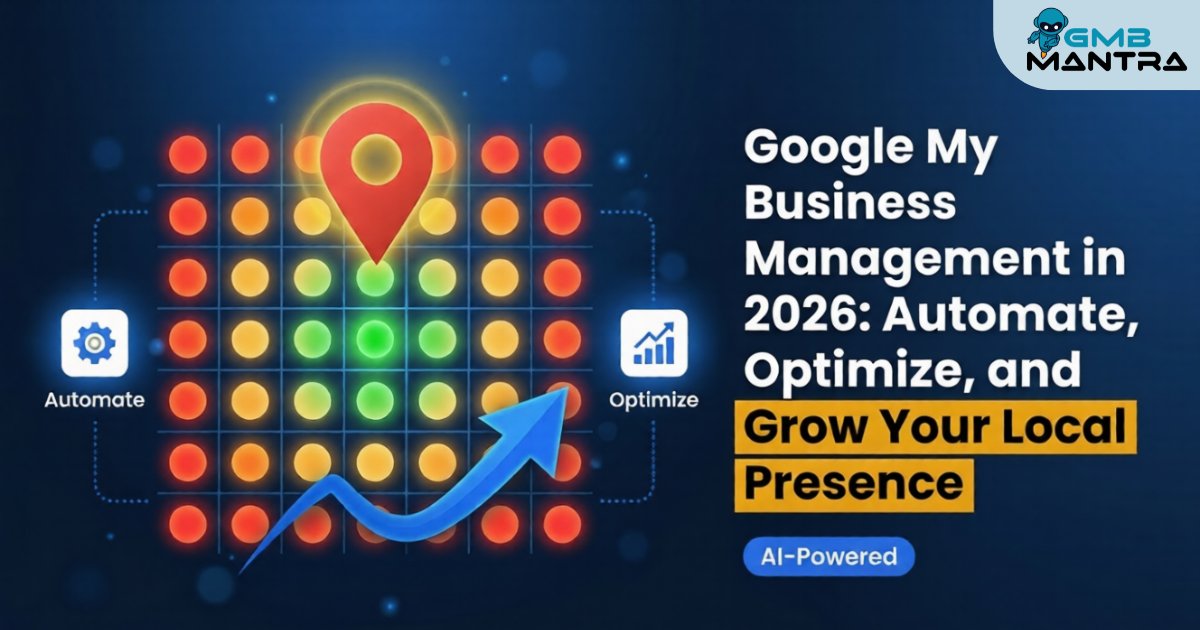
Google My Business Management in 2026: Automate, Optimize, and Grow Your Local Presence
I was staring at a dashboard showing 14 locations, all with stale posts, three unanswered negative reviews aging past 48 hours, and citation data that looked like it had been through a blender. That was a Tuesday. The client called it "manageable." I called it a local SEO fire. And honestly, it's the exact kind of mess that taught me everything I know about what actually works in Google My Business management today—and what absolutely doesn't.
Here's the promise: By the end of this guide, you'll have a phased system to automate, optimize, and scale your Google My Business optimization across any number of locations without the silent failures that tank most profiles.
Before You Touch Anything: The Pre-Flight Check
You need four things locked down before any of this matters:
- A verified, complete Google Business Profile for every location. No partial listings.
- Clean NAP data (name, address, phone) confirmed across your top 20 directories. Not assumed. Confirmed.
- Access to a GMB management tool that handles posting, reviews, and reporting. Free dashboards won't cut it past one location.
- A transaction trigger for review requests—whether that's a POS integration, CRM webhook, or even a manual SMS flow.
Stop/Go test: Can you pull up your GBP insights right now and tell me your impression trend for the last 30 days? If you can't, fix access first.
Phase 1: Automate Your Posting Without Getting Shadowbanned
This is where most people get burned. GBP AI Posting tools are everywhere in 2026, and they're genuinely useful—until they create near-duplicate content across your locations and Google quietly suppresses your posts. I've seen profiles lose 50% of impressions overnight from this exact issue.
Here's the execution path:
- Connect your GMB management software to your inventory or service feed. Set Post Scheduling for 2-3 updates per week, targeting peak local search windows (typically Tuesday and Thursday mornings for service businesses).
- Critically: Before any post goes live, inject a location-specific hook. Not just the city name—reference a local event, a seasonal detail, something that makes the content unique to that profile.
- Enable Hands-Free Posting for scale, but build in a manual review gate for at least the first 30 days.
Visual Checkpoint: You should see a "Powered by AI" badge under auto-posts in your GBP dashboard, and green checkmarks on scheduled content in your management platform's calendar view.
Verification: Check GBP insights after two weeks. If weekly posts show greater than 10% engagement lift and zero suppression warnings, your automation is clean.
The friction here is real. 2026 data shows AI tools boost post engagement by 40%—but only when outputs aren't generic. Append location timestamps and specific service mentions to every AI-generated draft. That one tweak saved three of my client accounts from invisible post suppression.
Phase 2: Build a Review Engine That Actually Converts
Review Request Automation via SMS hooks pulls 40% higher response rates than email alone. That stat surprised me too, but it holds up across high-volume locations.
The problem? About 30% of automated review requests fail because they land in carrier spam filters, especially post-iOS updates.
Do this:
- Set up an SMS Review Funnel triggered by completed transactions. Timed QR code prompts at checkout convert 25% more completions into five-star reviews.
- Prefix every request with customer-first phrasing—"Your feedback?" outperforms "Leave us a review" by a wide margin.
- A/B test shortcodes monthly. Carrier filtering changes constantly.
- Deploy an AI Review Assistant to draft personalized replies. But—and I can't stress this enough—feed it your last 10 manual responses as training data. Without that, the platform detects templated replies and flags them as generic.
Visual Checkpoint: Your reputation management dashboard should show star-rated review widgets with rich snippets live on your site, and an 80%+ positive sentiment delta post-rollout.
Verification: Trigger a sample review request. If it hits the customer's inbox and logs in your reporting within 60 seconds, the No-Code Workflow is solid.
> Drowning in review responses across locations? This is exactly the problem GMBMantra was built to solve. It uses sentiment analysis to generate instant, personalized replies from a single dashboard—so negative reviews get triaged in minutes, not days. Worth checking if you're managing more than a couple profiles.
Phase 3: <a href="https://gmbmantra.ai/local-seo-automation/citation-building">Citation Management</a> and Rank Tracking That Compounds
Here's what I was looking at the data on recently, and it's wild: 50% of multi-location profiles suffer citation inconsistencies that directly cause rank drops. Local SEO Audits flag proximity mismatches that can tank map pack visibility by 30%.
The fix is methodical, not flashy:
- Run Citation Building audits quarterly. Sync NAP across 50+ directories using a bulk-upload via Sheets script—Gemini Scripting makes this surprisingly painless without dev help.
- Set up Rank Tracking for your top 5 local queries per location. If you hold top-3 in the local pack for those queries, your citation sync is working.
- Use Roll-Up Reporting to aggregate review scores, impression data, and ranking positions for multi-location clients in one view. This is where competitor analysis becomes actionable—you're comparing your engagement heatmaps against the local pack, not guessing.
Visual Checkpoint: Multi-location views should display roll-up heatmaps with orange "Engaged" icons for high-response inboxes, and Gemini-scripted Sheets dashboards flashing real-time impression spikes.
Verification: Run your position tracker. Local pack ranking holding top-3 for 5 tracked queries confirms citation sync success.
One thing that trips people up: Google Workspace token expiry in no-code tools. Set Zenphi to auto-refresh OAuth every 7 days via a calendar trigger. I lost two weeks of automation data before figuring that one out.
The Ugly Truth: Ghost Errors Nobody Warns You About
Problem | The Weird Fix | Context |
|---|---|---|
Posts vanish from GBP feed silently | Append location timestamps and unique hooks to every AI-generated post | Shadow bans from duplicate content |
Review requests get 0% response | Rotate shortcodes monthly, use customer-first phrasing | Carrier spam filters post-iOS updates |
Impressions drop 50% overnight | Bulk-upload NAP via Sheets script, force GBP re-verification | Citation drift from un-synced directories |
AI replies flagged as generic | Train assistant on your last 10 manual responses | Platform detects templated patterns |
Automation workflows fail with no alert | Auto-refresh OAuth tokens via calendar trigger | Google Workspace token expiry |
Negative reviews left untriaged tank sentiment by 15-20% within 48 hours. That's not a slow bleed—it's a cliff. If you're managing Google My Business across multiple locations and don't have automated sentiment thresholds set, you're running blind.
> Scaling local SEO across locations?GMBMantra's AI-powered dashboard handles review triage, post scheduling, and keyword heatmaps from one place—so ghost errors like untriaged negative reviews don't slip through. It's the GMB management tool I'd point anyone toward who's past the DIY stage.
How Long Does Google My Business Optimization Take to Show Results?
Initial automation setup yields review lifts in 2-4 weeks. Full optimization—impressions, engagement, rank stability—compounds over 3-6 months. 70% of local businesses using GBP automation see 2x review volume growth in that window. No honest practitioner will promise ROI timelines beyond 6 months because local competition variables are too unpredictable.
Can You Manage Google My Business Effectively With Free Tools?
Free tools work for a single location with low review volume. But freemium GMB management software users churn at 60% before reaching full optimization. Once you're past two locations or 20+ reviews per month, a dedicated platform like GMBMantra pays for itself in time saved on review responses and citation audits alone.
What's the Biggest Mistake in GMB Management Software Selection?
Choosing based on posting features alone. The real differentiator is how the tool handles competitor analysis, citation management, and automated review triage together. Disconnected tools create the exact sync failures and ghost errors that tank profiles.
How Do Local SEO Tools Differ From General SEO Platforms?
Local SEO tools prioritize proximity signals, NAP consistency, and map pack tracking. General platforms miss citation drift and review sentiment—the two factors that cause 65% of local ranking volatility in 2026.
So here's what I'd do next: pick the phase where your current setup is weakest—posting, reviews, or citations—and fix that one first. Trying to automate everything simultaneously is how profiles break. Start narrow, verify with the checkpoints above, and then scale. That's how local presence actually grows.