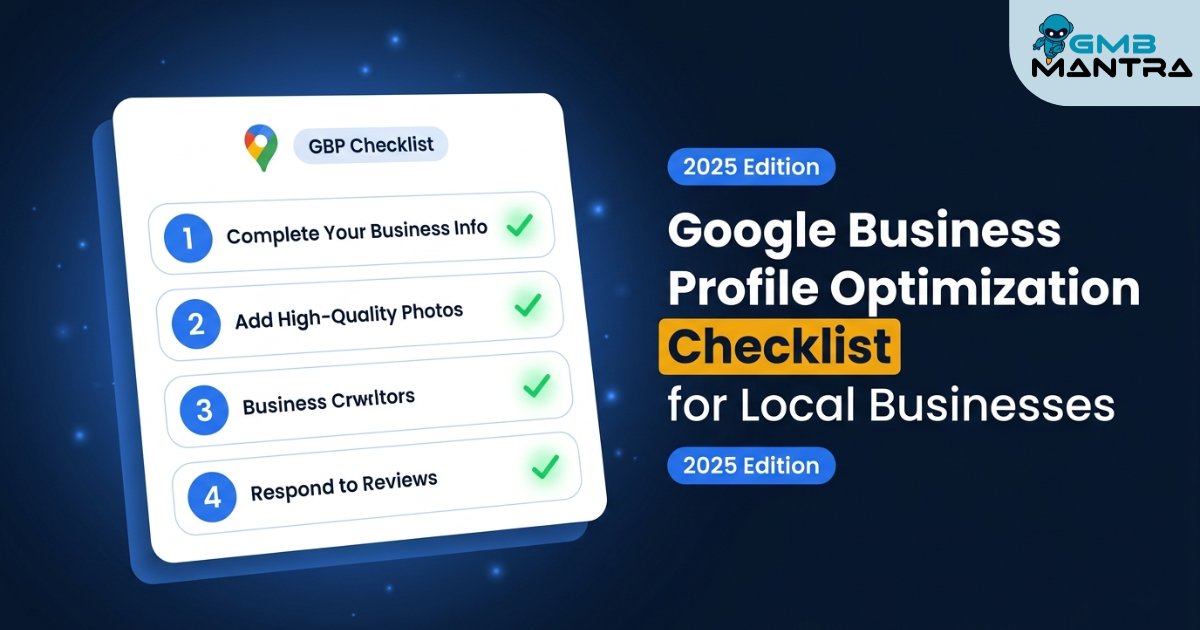
Google Business Profile Optimization Checklist for Local Businesses
The Google Business Profile Optimization Checklist That Actually Works in 2026
I was reviewing GBP Insights for a plumbing client last month when I noticed something bizarre: their profile showed 2,400 monthly impressions but only 47 actions. That's a 1.9% action rate—basically invisible. When I pulled up their profile, the problem was obvious. Their services section was completely empty. Google's AI had no idea what they actually did, so it was showing them for irrelevant queries like "bathroom showroom" instead of "emergency plumber."
This wasn't a ranking problem. It was a completeness problem. And it's where most local businesses quietly lose 60-70% of their potential visibility.
Reader Promise: By the end of this guide, you'll have a practitioner-tested checklist that eliminates the ghost errors causing verification friction, ranking drops, and conversion leaks in your Google Business Profile.
Pre-Flight Check: What You Need Before Starting
Before touching your GBP, answer this question: Can you describe your primary service in one sentence that matches how customers search for you?
If you can't, stop. Your category strategy will fail.
Here's what you need locked down:
- Physical address access (virtual offices trigger 60% verification rejection rates)
- Admin-level GBP access (not just "manager" permissions)
- Your actual operating hours (not aspirational "we're always available" nonsense)
- A list of your top 5 services using customer language, not industry jargon
Stop/Go Test: Open your GBP dashboard. Do you see a green "Complete Profile" badge? If not, you're starting from a deficit. That's fine—we'll fix it. But know that incomplete profiles are systematically excluded from AI Overviews in 2026.
Phase 1: Foundation Accuracy (The NAP Consistency Audit)
The Directive Steps
- Verify your business name matches your legal entity exactly—no keyword stuffing. Google's 2026 crackdown is aggressive. If your name is "Smith Plumbing," don't list it as "Smith Plumbing | Emergency Plumber OKC."
- Confirm your address is a physical location you can receive mail at. Service-area businesses still need a real address (you can hide it from customers later).
- Standardize your phone number to one primary contact line. Use the same format everywhere (e.g., (405) 555-1234, not 405.555.1234).
Visual Checkpoint
When you save your NAP, the GBP dashboard should show no red warning flags under "Business Information." If you see "Address needs verification," you've got citation conflicts elsewhere.
The Verification
Run a quick Google search: "Your Business Name" + "Your City". Check the top 5 directory results (Yelp, Yellow Pages, BBB). Does your NAP match character-for-character? Each inconsistency dilutes your prominence and creates verification friction.
The Expert Nuance
Here's what most guides won't tell you: NAP inconsistencies aren't just a ranking problem—they trigger Google's duplicate-detection algorithm. I've seen businesses with three "versions" of their profile floating around because old citations pointed to slightly different addresses. Consolidation takes 4-8 weeks to propagate, so fix this first.
Phase 2: Primary Category Strategy (The Relevance Anchor)
The Directive Steps
- Choose your primary category based on your highest-revenue service, not your broadest offering. If 70% of your revenue comes from "emergency plumbing," don't pick "general contractor."
- Add 2-3 secondary categories that capture adjacent services. But test them. Categories like "handyman" can dilute relevance for specialized queries.
- Monitor your query distribution in GBP Insights for 4 weeks. If you're showing up for irrelevant searches, your category is wrong.
Visual Checkpoint
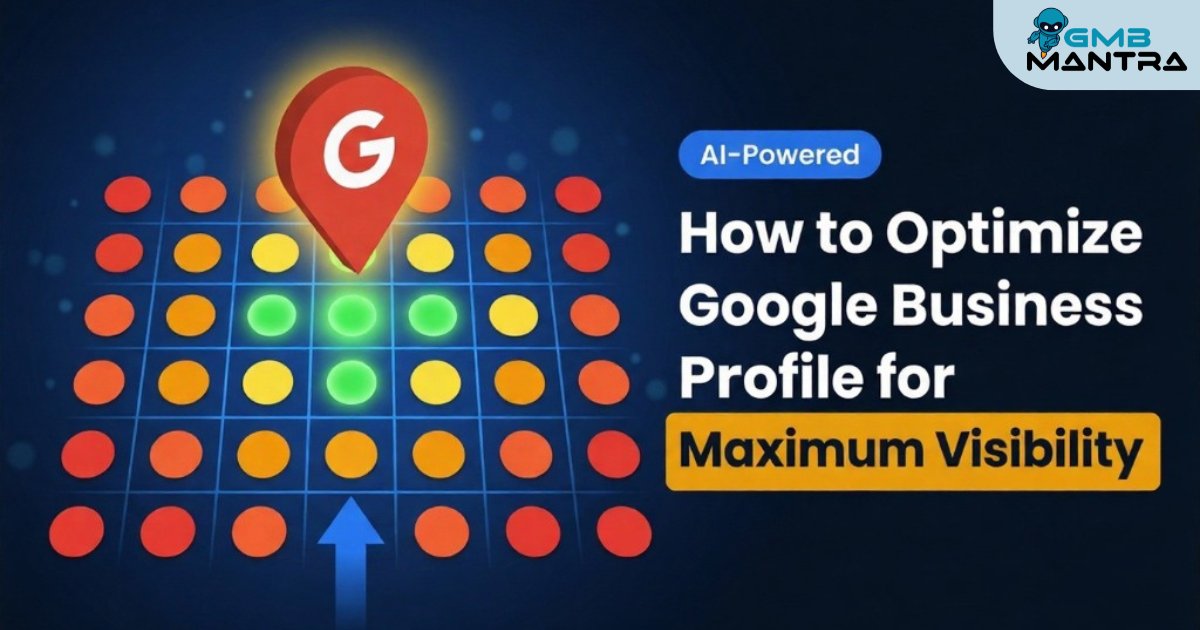
In GBP Insights, your "How customers search for your business" section should show 70%+ queries related to your primary category. If you're seeing random long-tail queries, your category mix is too broad.
The Verification
Ask yourself: "If I were searching for my own business, would I use this category term?" If not, adjust. Category misalignment reduces relevance for target queries by 40-60%.
The Expert Nuance
I tested three primary categories for a client: "plumbing contractor," "plumber," and "handyman services." The "plumbing contractor" category outperformed by 2.3x in impressions. Why? Because it matched the language in LocalBusiness schema and citation stacking across industry directories. Category selection isn't just about search volume—it's about semantic alignment across your entire local presence.
Phase 3: Services Section Completeness (The AI Eligibility Gate)
This is where most businesses lose. The services section is now the #1 factor for AI Overview inclusion. Leave it blank, and you're invisible to Google's AI-generated local summaries.
The Directive Steps
- List every primary service you offer. Use customer search language: "emergency plumbing," "water heater repair," "drain cleaning"—not "comprehensive pipe solutions."
- Add 50-100 word descriptions for each service. Include the problem it solves and your service area radius.
- Upload 1-3 photos per service showing your team actually performing the work. Stock photos don't count.
- Add pricing where applicable. Businesses that display pricing see 12-18% higher conversion rates.
Visual Checkpoint
Your "Services" tab should show no empty fields. Each service should have a description, at least one photo, and ideally a price or price range. See our pricing for details on how to display pricing.
The Verification
Go to your GBP profile on mobile. Scroll to "Services." Can a customer understand exactly what you do and what it costs without clicking through to your website? If not, keep adding detail.
The Expert Nuance
Services section completeness is the difference between appearing in AI Overviews and being buried. In our vertical, profiles with complete services sections appear in AI-generated summaries 60% more often than incomplete profiles. This isn't a nice-to-have anymore—it's a ranking factor.
Phase 4: Review Velocity & Response Workflows
Review velocity—the frequency and recency of customer reviews—is now a primary ranking signal. Businesses posting 2+ reviews monthly outrank competitors with stale review profiles by 3-4 positions.
The Directive Steps
- Set up a review collection system. Whether it's a post-service email, an SMS campaign, or a QR code on invoices, automate the ask.
- Respond to every review within 48 hours. Response rate above 90% signals active management to Google's algorithm.
- Use response templates sparingly. Google's sentiment analysis detects copy-paste replies. Personalize at least the first sentence.
Visual Checkpoint
Your GBP profile should show a consistent stream of reviews—at least 2 per month. Check your "star distribution." If you're below 4.2 stars average, you've got a service quality problem, not a GBP problem.
The Verification
Look at your competitors' review profiles. Are they getting more reviews per month than you? If yes, their review velocity is outranking you. Match or exceed their frequency.
> Automate Your Review Workflow Without the Copy-Paste Feel > We built GMBMantra to solve exactly this problem—AI-powered review responses that use sentiment analysis to personalize every reply. You get the velocity signal Google rewards without the robotic templates that turn customers off. It handles review analytics, response templates, and reputation protection from a single dashboard, so you're not manually monitoring five different platforms. > See how GMBMantra automates review management →
Phase 5: Post Freshness & Content Signals
Posting weekly (vs. monthly) correlates with 35% higher local pack visibility. Google treats regular posts as a vitality signal—proof your business is active and responsive.
The Directive Steps
- Post weekly. Mix content types: announcements, offers, tips, project showcases.
- Use clear CTAs. Every post should have a "Call Now," "Learn More," or "Book Online" button.
- Track engagement. Posts with 5-15% click-through rates are performing well. Below 3% means your content isn't relevant.
Visual Checkpoint
Your "Posts" tab should show at least one post per week for the past 8 weeks. If there are gaps, you're signaling inactivity.
The Ugly Truth: Ghost Errors That Kill Rankings
Problem
The Weird Fix
Why It Happens
Incomplete Services Section
Manually add every service with descriptions. Don't assume Google auto-populates from your website.
Businesses think Google scrapes their site. It doesn't. Empty services = invisible to AI systems.
Virtual Office Addresses
Switch to a physical address or use your home address (you can hide it).
Virtual offices trigger 60% verification rejection. Google's trust algorithm flags them.
Duplicate Listings
Use GBP support to consolidate. Takes 4-8 weeks to propagate.
Old citations, location changes, or directory auto-creation create duplicates that dilute authority.
Keyword-Stuffed Business Names
Revert to your exact legal name. Visibility recovers in 3 weeks.
Google's 2026 crackdown triggers manual review and potential suspension for keyword stuffing.
Ignored Q&A Section
Answer the top 8 objection questions. Reduces conversion friction by 18-22%.
Businesses see Q&A as vanity. It's actually a pre-call objection removal tool.
FAQ: Implementation Realities
How long does GBP optimization take to show results?
Expect 4-8 weeks for category and citation changes to propagate. Review velocity and post freshness show impact in 2-3 weeks. Schema markup and services section updates can improve AI Overview eligibility within 10-14 days.
Can I optimize GBP without a website?
Yes, but you're leaving conversion opportunities on the table. GBP-to-website alignment (especially schema markup) is a ranking factor. At minimum, ensure your GBP services match your site's service pages word-for-word.
What if my competitors are keyword-stuffing their names and ranking higher?
They're on borrowed time. Google's 2026 algorithm update is systematically flagging keyword-stuffed names. Focus on services section completeness, review velocity, and citation stacking—those are sustainable ranking factors.
How do I track GBP performance beyond basic Insights?
Use rank tracking for your primary category in your service area. Monitor query distribution weekly. If you're showing up for irrelevant queries, adjust your secondary categories. Track action rate (clicks + calls + directions) as your primary KPI—aim for 15%+ of impressions.
Do photos actually impact rankings?
Yes. Businesses with 30+ recent photos rank higher than competitors with fewer than 10. Photos are trust and activity signals. Upload customer project photos, team shots, and facility images monthly.
What Happens Next
GBP optimization isn't a one-time setup—it's an ongoing feedback loop. Your competitors are iterating. Google's algorithm is evolving. The businesses that win in local search treat their GBP like a living asset: weekly posts, monthly photo uploads, consistent review collection, and quarterly audits of citation consistency.
The difference between a 1.9% action rate and a 15% action rate isn't luck. It's completeness. It's relevance. It's showing Google's AI exactly what you do, who you serve, and why you're the best match for the query.
Start with Phase 1. Fix your NAP. Then move to categories. Then services. Don't skip steps. The businesses ranking in the local pack right now didn't get there by guessing—they executed the checklist.
And if you're managing multiple locations or drowning in review responses? That's exactly why platforms like GMBMantra exist—to automate the repetitive stuff so you can focus on the strategy that actually moves the needle.