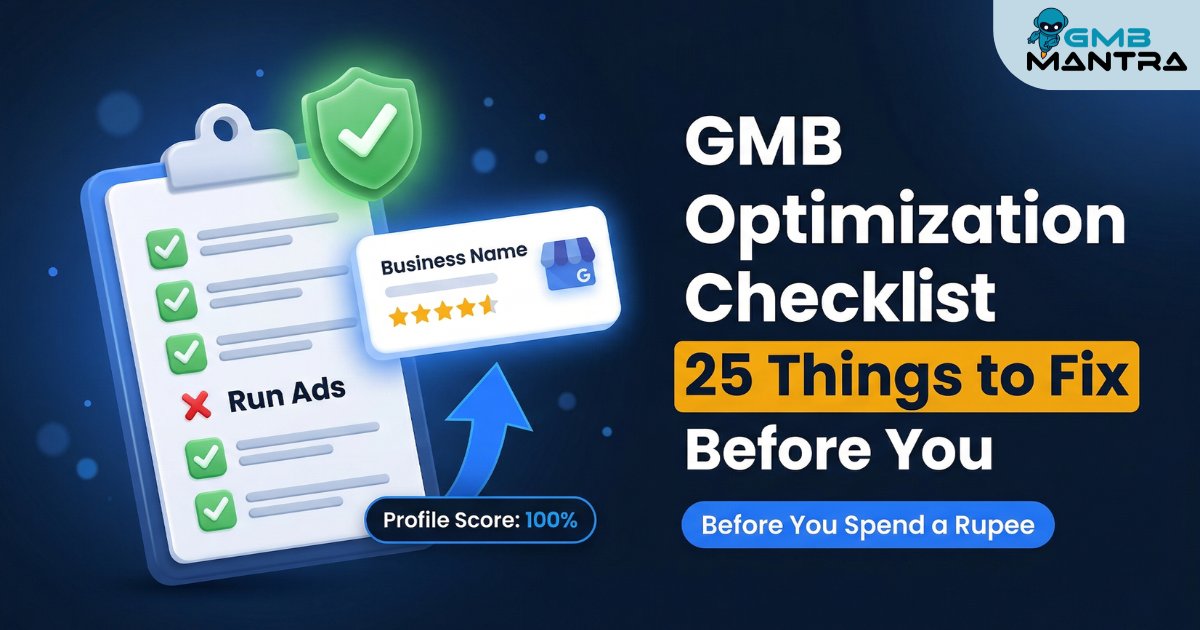
GMB Optimization Checklist: 25 Things to Fix Before You Run Ads
Last month I watched a client burn through $3,200 in Google Ads over 18 days—with a Google Business Profile that had the wrong phone number on four directories, zero posts in 90 days, and exactly one blurry photo of their storefront taken in the rain. Their profile audit took me eleven minutes. The problems were obvious. The wasted budget wasn't coming back.
Here's what I've learned after running hundreds of these pre-ad profile audits: the profile is the landing page for local ads. If your GBP is half-baked, your ad spend is half-wasted. Studies show optimized profiles see 250% more views and 70% more direction requests and calls compared to incomplete ones. Running ads on a broken profile is just paying Google to show people your mess faster.
By the end of this guide, you'll have a 25-point framework to audit, fix, and bulletproof your Google Business Profile before a single ad dollar goes live.
Before You Touch Anything: The Pre-Flight Check
You need three things ready:
- GBP Manager dashboard access with owner-level permissions
- A spreadsheet of your current NAP (Name, Address, Phone) exactly as it appears on your website, top 10 directories, and your GBP
- Competitor intel: search your primary keyword incognito and screenshot the top 3 local pack results
Stop/Go test: Can you log into your GBP dashboard right now and see a green "Verified" badge? If not, stop here—verification comes before everything.
Phase 1: Profile Optimization — The Foundation (Items 1–9)
This is where 65% of businesses already have problems, and most don't know it.
1\. NAP Consistency Audit. Pull your name, address, and phone from your GBP, website, Facebook, Yelp, Apple Maps, and at least five other directories. Every character matters. "St." vs. "Street" creates micro-discrepancies that suppress local pack visibility. I've seen profiles vanish from Maps over an apartment number formatted differently on Yelp.
2\. Primary Category Selection. This is the single biggest ranking lever for Maps relevance. Don't pick "Marketing Agency" when "Digital Marketing Agency" matches your actual service. Spy on the top-3 pack rivals' categories via incognito search—if they're all using a more specific category, you probably should be too.
3\. Secondary Categories. Stack 3–5 that mirror competitor packs and capture long-tail service queries. But avoid category stuffing—Google flags it as manipulation and suspends profiles. I've seen it happen twice this year.
4\. Business Description. Write it in conversational language, not keyword salad. This matters for AI visibility now more than ever—AI Overviews favor profiles that sound like humans wrote them.
5\. Service Alignment. List every service with descriptions that match your website pages verbatim. If your site says "residential plumbing repair" and your GBP says "plumbing services," AI justifications will ignore your profile. Service alignment isn't optional anymore.
6\. Attribute Flags. Add every applicable attribute—"wheelchair accessible," "women-owned," "veteran-led." These hit eligibility for voice searches and filtered results that most competitors skip entirely.
7\. Contact Info & Links. Verify your website URL, appointment link, and phone number. Broken links on a profile you're sending paid traffic to is money on fire.
8\. Service Areas. Keep your radius to your verified operations zone. Overly aggressive service areas trigger suspension risk. Add photo proof of physical presence if you've expanded recently.
9\. Schema Markup on Your Website. Implement local schema markup to reinforce GBP data in rich snippets. Embed your Google Map—it should render with your exact GBP pin. If there's a mismatch, your proximity signals are fighting each other.
Visual Checkpoint: Open your profile in edit mode. You should see zero red flags or incomplete field indicators. Every section filled, every link clickable.
Verification: Search your main keyword incognito. If you're in the top-3 pack with services and photos visible, move on. If not, revisit categories and service alignment before proceeding.
Phase 2: Photo Management & Post Scheduling — The Activity Engine (Items 10–17)
Google's algorithm reads activity signals like a heartbeat monitor. Stale profiles drop out of local packs in under 30 days. 80% of businesses fail post cadence—don't be one of them.
10\. Photo Audit. Upload at minimum 10 photos: exterior, interior, team, products, and action shots. Tag them with service-relevant descriptions. One client saw a 35% bump in profile actions just from replacing stock-looking images with real team photos.
11\. Photo Quality & Freshness. Remove anything blurry, outdated, or irrelevant. Photo management isn't a one-time task—add new images monthly.
12\. Cover & Logo. Your cover photo is the first thing people see in Maps. Make it count. Logo should be clean and recognizable at thumbnail size.
13\. Post Scheduling — Weekly Minimum. Hit post cadence religiously. Use update, event, and offer post types. Each one needs a clear CTA. Schedule them at peak engagement times you can pull from GBP Insights.
14\. Post Content Strategy. Write posts in a "what's new" conversational style. This directly feeds AI visibility. Stiff, corporate-sounding posts get ignored by both algorithms and humans.
15\. Post Scheduling Consistency. Map out 4–8 weeks of content before ads go live. Ramp up activity signals so Google sees a healthy, active profile when ad traffic starts flowing.
16\. Video Content. Short clips (under 30 seconds) of your team, workspace, or service in action. These get disproportionate engagement in local results.
17\. Seasonal & Promotional Posts. Align with your ad campaigns. If you're running ads for spring services, your GBP posts should reflect the same messaging.
Visual Checkpoint: Post a test update. It should appear live within 24 hours with engagement icons visible. If it's delayed, check your messaging toggle settings.
Verification: After 7 days of consistent posting, check GBP Insights. Actions should outpace views by at least 5%. Flatline? Audit your attributes and services section.
Phase 3: Review Management & Reputation Protection (Items 18–25)
Review-rich profiles rank 2.5x higher in local packs. This isn't a "nice to have"—it's a ranking factor that directly impacts your ad ROI.
18\. Review Velocity. You need a steady stream, not a burst. Set up automated SMS or email requests triggered post-service. Daily responses embedding service keywords give you a semantic boost.
19\. Response Templates. Build a library of response templates for positive, neutral, and negative reviews. But customize each one—copy-paste replies signal laziness to both Google and potential customers.
20\. Review Analytics & Reporting. Track review velocity, sentiment trends, and keyword frequency weekly. GBP Insights will show you impression spikes that correlate with review activity.
21\. Negative Review Protocol. Respond within 24 hours. Acknowledge, don't argue. This is reputation protection in its most visible form—every potential customer reads your responses to bad reviews.
22\. Review Solicitation Compliance. Don't incentivize reviews. Don't gate them. Google's guidelines are clear, and violations get profiles suspended.
23\. Staff Review Seeding. (Yes, this is a thing.) Encourage your team to leave honest reviews about their work experience. It adds authenticity and volume early on.
24\. Citation Cleanup. Run a full citation cleanup—suppress duplicates, correct outdated listings. Unmonitored data drift hits 40% of profiles annually and silently kills conversions.
25\. Quarterly Profile Audit Schedule. Combat data drift with scheduled audits triggered by Insights drops. Category mismatches alone reduce relevance by 50% in AI results. This isn't set-and-forget.
Visual Checkpoint: Your Insights graph should show impression and action spikes within 2–3 weeks of implementing review management changes.
Verification: Spot-check your NAP on 10 directories. 100% match means go. Any variance means stop and clean up citations before spending on ads.
The Ugly Truth: Ghost Errors That Kill Ad ROI
Problem
The Weird Fix
Where to Look
Profile invisible despite completeness
Manual citation audit; bulk suppress duplicates
BrightLocal or similar tools
Low impressions post-ad launch
Swap primary category to match top-3 pack rivals; wait 4–8 weeks
Incognito competitor search
Reviews not boosting rankings
Automate keyword-rich reply templates; seed with staff reviews first
Review analytics dashboard
AI Overviews ignoring profile
Rewrite services and posts in conversational tone; post weekly
GBP post scheduler
Many businesses run ads on half-optimized profiles, wasting 40–60% of their budget. These aren't edge cases—they're the norm.
> Managing all 25 items across multiple locations gets chaotic fast.GMBMantra handles profile optimization, review management with AI-powered response templates, post scheduling, review analytics and reporting, and reputation protection from a single dashboard—with sentiment analysis and keyword heatmaps built in. It's what I point clients toward when manual audits stop scaling.
FAQs
How long does a full GMB optimization take before running ads?
Expect Week 1 foundations to yield a 20–50% impression lift. The full checklist takes 4–8 weeks for measurable pack gains. Review and post compounding takes 3–6 months for sustained dominance. Don't rush ads before the foundation is set.
Why is my profile not showing in AI Overviews?
Your GBP services likely don't match your website copy. Align descriptions using exact customer-search phrases, switch posts to conversational language, and maintain weekly post scheduling. Category mismatches reduce AI relevance by 50%.
How do I fix review collection that's too slow before launching ads?
Automate SMS and email requests immediately post-service. Respond to every review within 24 hours using response templates with service keywords. Track review velocity through review analytics and reporting weekly.
What's the fastest way to catch data drift on my profile?
Schedule monthly profile audits triggered by GBP Insights drops. Use a centralized profile management tool to monitor NAP consistency, photo freshness, and post cadence across all locations simultaneously.
You've got the checklist. The question isn't whether these 25 items matter—it's how many of them are broken on your profile right now. Audit first. Fix everything. Then turn on the ads.
> Ready to automate the audit? GMBMantra's profile optimization and review management tools can surface what's broken in minutes, not hours.