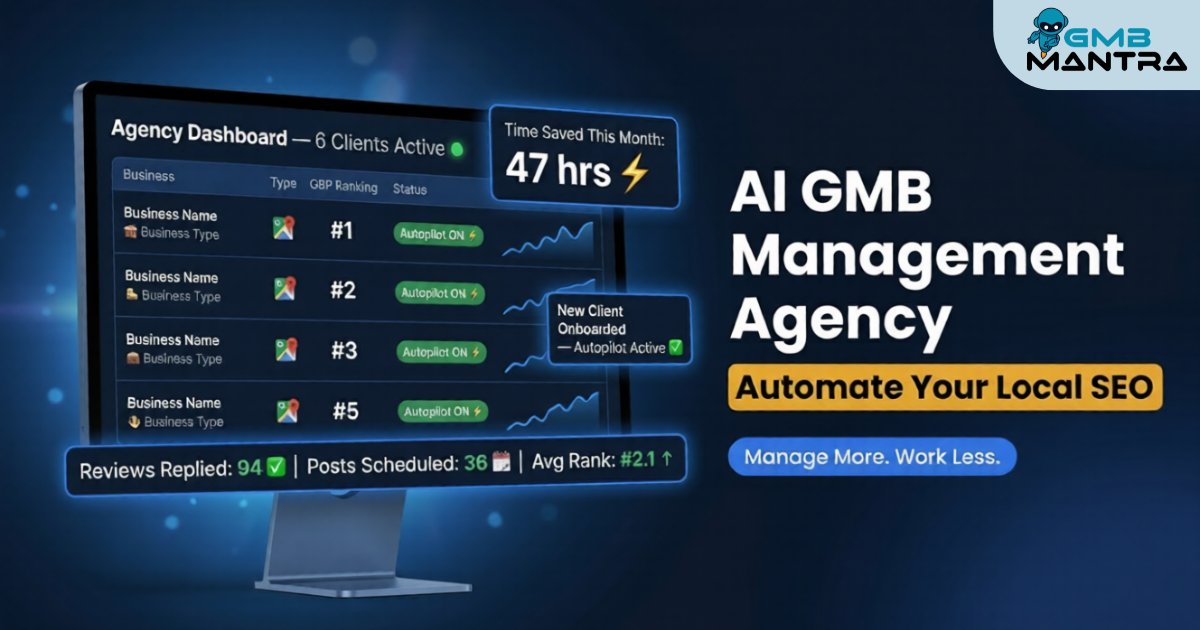
AI GMB Management Agency: Automate Your Local SEO
I spent the better part of a Tuesday afternoon last year updating NAP data across 53 directories for a single client location. One by one. Copy, paste, verify, repeat. By directory number 34, I'd already found two conflicting phone numbers I'd apparently entered myself three weeks prior. That's when it hit me — I wasn't doing local SEO anymore. I was doing data entry. Badly.
That moment was the pivot. Not a gradual shift, but a hard stop. Because if you're managing Google Business Profiles manually in 2025, you're not just wasting time. You're actively falling behind businesses that handed this work to an AI GMB management agency months ago.
By the end of this guide, you'll know exactly how AI-powered GMB management works, where it breaks, where it shines, and how to decide if it's the right move for your business — whether you run one location or a thousand.
Before You Read Further: The Readiness Check
This guide assumes you already have a claimed, verified Google Business Profile. If you don't see a green "Verified" badge on your GBP dashboard, stop here and handle that first. Everything below builds on that foundation.
Your Stop/Go test: Can you log into your Google Business Profile right now and confirm your business name, address, and phone number are accurate?
If yes, keep going.
You'll also want access to your review history and a rough idea of which local keywords matter to you. No fancy tools needed yet — just awareness.
Phase 1: Why Manual GMB Management Is Quietly Killing Your Rankings
Here's what most people don't realize: 46% of all Google searches carry local intent, and 78% of those local searches result in a purchase. Those numbers are staggering. But they only work in your favor if your GBP is optimized, consistent, and active.
Manual management made sense five years ago. You'd update your hours seasonally, respond to a few reviews when you remembered, maybe post a holiday greeting. That was "good enough."
It's not anymore.
Google's local algorithm now weighs engagement signals heavily — how fast you reply to reviews, how frequently you post, whether your NAP consistency holds across 50+ directories. Miss any of these, and your Map Pack position slides. Quietly. Without warning.
I've watched businesses lose page-one rankings overnight because a single directory had an old phone number. Not a dramatic penalty. Just a slow, silent demotion that nobody noticed until the phone stopped ringing.
What you should see if manual management is hurting you: Open your GBP insights. If weekly post impressions are flat or declining, and your review response rate is below 80%, that's your signal. The data doesn't lie — it just whispers.
Verification: Pull up your business on Google Maps from a device you've never used. Does the phone number match your website? Does the address auto-populate correctly? If there's even a minor discrepancy, you've got NAP drift.
Phase 2: What an AI GMB Optimization Agency Actually Does (Not What You Think)
The phrase "ai gmb optimization agency" gets thrown around a lot, and most people picture a chatbot answering reviews with "Thank you for your feedback!" on repeat.
That's not it. Not even close.
A real AI GMB management agency operates across four layers simultaneously:
Layer 1 — Profile Optimization. AI audits run daily (not weekly, not monthly — daily) to catch gaps in your categories, services, descriptions, and attributes. Think of it as a spell-checker for your entire local presence, except it's checking against what's actually ranking in your geo-grid, not just grammar.
Layer 2 — Review Intelligence. This is where sentiment analysis earns its keep. The AI doesn't just reply to reviews. It reads emotional tone, flags negative ones for priority handling, and drafts responses that match your brand voice. The good platforms learn your tone within about two weeks of training on owner-written samples.
Layer 3 — Content Automation. GBP posts get scheduled with local keywords baked in — not generic "Happy Monday!" filler, but content seeded with hyper-local references pulled from competitor gap analysis.
Layer 4 — Citation Syndication. Your NAP gets pushed to directories automatically, with duplicate detection running in the background to catch conflicts before they cause damage.
Visual checkpoint: On a properly configured AI dashboard, you should see green checkmarks across your NAP consistency panel and a geo-grid heatmap that's trending from red to green in your target neighborhoods.
Verification: Check the Local Rank Tracker. If 80% of your tracked keywords are hitting the top 10 in your geo-grid within four weeks, the optimization is working.
Phase 3: The Four Benefits That Actually Matter
I could list twenty features. But you don't need twenty. You need the four that move revenue.
1. Review Response at Scale — Without Sounding Like a Robot
Here's the thing about review auto-replies: they work brilliantly or they get you flagged as spam. There's almost no middle ground.
The difference? Training data. Platforms that let you feed in 50+ real responses you've written teach the AI your actual voice. The result is replies that are indistinguishable from what you'd write yourself — just faster. We're talking 100% response rates maintained 24/7, which Google's algorithm rewards directly through engagement signals.
(I know, "just train the AI" sounds simple. It's not. I'll get to the ugly parts in a minute.)
2. Geo-Grid Rank Tracking That Shows You the Neighborhood-Level Picture
Standard rank trackers tell you "you're #4 for plumber near me." Helpful, sure. But a Local Pack heatmap shows you that you're #1 in the west side of town and invisible three miles east. That granularity changes your entire strategy — you stop guessing and start targeting.
3. Citation Management That Doesn't Make You Want to Quit
Remember my 53-directory Tuesday? With citation syndication, updates push everywhere simultaneously. But the real value is the duplicate detection. Silent GBP suspensions from duplicate citations are more common than anyone admits — the automation catches conflicts you'd never spot manually.
4. Post Scheduling With Actual Strategic Intent
Automated GBP posts aren't just about consistency. They're about feeding Google the engagement signals it craves. The trick is using local keywords from competitor gap analysis, not generic promotional copy. When done right, you should see a 20%+ lift in weekly post impressions.
Verification across all four: Audit your review sentiment dashboard. If 90% of AI-generated replies pass without spam flags, your voice training succeeded. Scan your citation dashboard — zero NAP mismatches across directories signals clean syndication.
Phase 4: Manual vs. AI — The Honest Comparison
I'm not going to pretend AI replaces human judgment entirely. It doesn't. But here's what the numbers look like side by side:
The gap isn't subtle. And it widens with every location you add. If you're managing bulk updates across hundreds of locations, manual approaches hit API-level friction that AI platforms handle through staggered geo-grid batches — roughly 10 posts per location per day to avoid throttling.
The Ugly Truth: Ghost Errors Nobody Warns You About
Alright, let's talk about the messy stuff. Because every "AI fixes everything" pitch conveniently skips the failure modes.
That first one — silent ranking drops from NAP drift — is the ghost error that haunts me. I've seen it tank a business's calls by 30% before anyone noticed the cause. Weekly AI audit alerts are the only reliable prevention I've found.
Where GMBMantra Fits Into This
So after spending years wrestling with these exact problems — the NAP nightmares, the robotic review replies, the "why did my post not publish" mysteries — I started paying close attention to which platforms actually solved them versus which ones just added another dashboard to check.
> Ready to stop managing your GBP manually? > GMBMantra's Leela AI learns your brand voice for review responses, runs daily AI audits to catch optimization gaps, and gives you geo-grid heatmaps with keyword tracking — all from a single dashboard. We built it because we were tired of the same problems you're reading about right now. > Start automating your Google Business Profile with GMBMantra →
What stood out about GMBMantra specifically: the sentiment analysis on reviews isn't just "positive/negative" binary sorting. It reads nuance. And the white-label dashboard is genuinely useful if you're an agency managing multiple client locations — real-time metrics without the reporting delays that plague most multi-location tools.
The Leela AI voice training takes about two weeks with good sample data. Not instant. But once it's dialed in, the review responses are genuinely hard to distinguish from human-written ones. That's the bar.
FAQ: The Implementation Questions That Actually Matter
How long before I see ranking improvements from AI GMB management?
Expect initial movement in 1-4 weeks with consistent AI audits and posts. Full Map Pack positioning typically takes 1-3 months as citation authority builds and engagement signals compound. Year-over-year growth data becomes meaningful around the 6-month mark.
Why does my Local Rank Tracker show wildly different results day to day?
Volatile tracking data usually means you're checking broad queries without geo-grid filtering. Enable hyper-local geo-grid checks to get stable, neighborhood-level accuracy. Ignore city-wide averages — they mask what's actually happening.
How do I fix a GBP suspension caused by citation errors?
Reclaim the listing manually first. Then delete duplicate citations through directory tools one at a time — don't bulk-delete. Resubmit clean NAP data only after confirming zero mismatches across your core directory network.
Can AI review responses actually match my brand's tone?
Yes, but only with proper training. Feed the platform 50+ real responses you've personally written. Without that training data, AI replies default to generic phrasing that triggers spam filters. The investment upfront is worth the 100% response rate you'll maintain afterward.
Is AI GMB management worth it for a single-location business?
Absolutely. Single locations benefit from the daily audit cycles and consistent posting that most owners can't maintain manually. You don't need thousands of locations to justify the time savings — even one profile managed by AI outperforms one managed sporadically by a human.
What happens if the AI posts content that's off-brand or inaccurate?
Good platforms include approval workflows. Set up a review-before-publish gate for the first month while the AI calibrates. After that, spot-check weekly. The friction point here is real, but it's temporary — and it's far less friction than writing every post yourself.
The shift from manual to AI-powered GBP management isn't coming. It happened. The businesses winning in local search right now aren't working harder — they're running daily AI audits, maintaining 100% review response rates, and tracking rankings at the neighborhood level while their competitors are still copy-pasting NAP data into directories by hand.
Your next move is straightforward.
> Get started with GMBMantra > See what AI-powered GBP management looks like when it's built around the problems that actually cost you rankings. Explore GMBMantra →