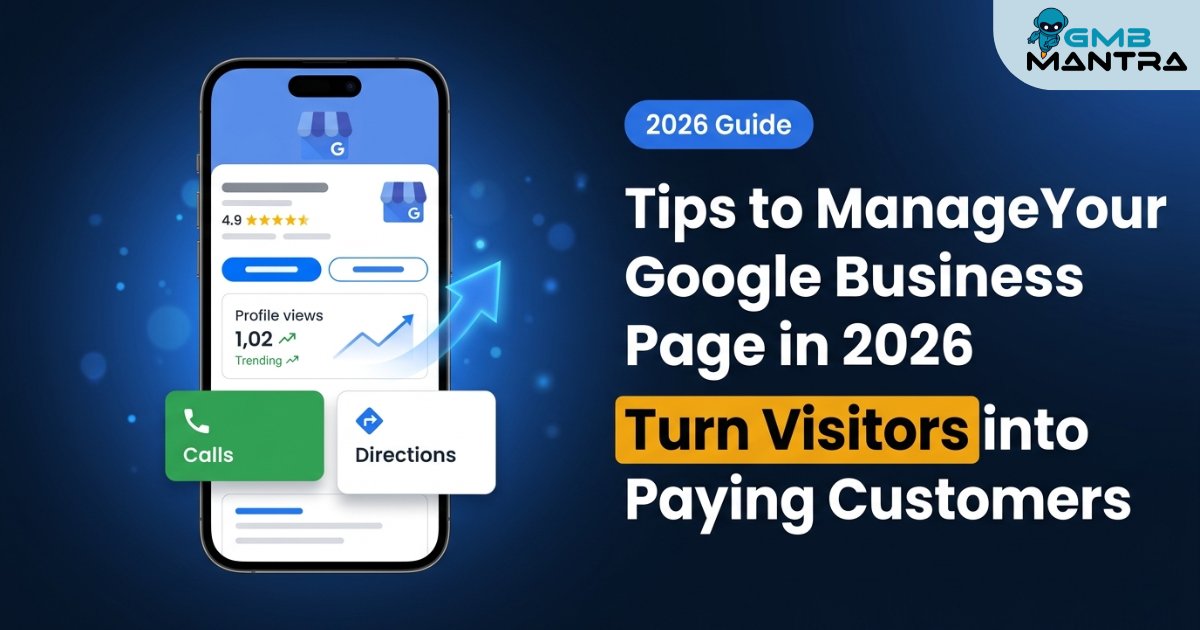
Tips to Manage Your Google Business Page in 2026 and Turn Visitors into Paying Customers
Last month, I watched a client lose their 4.7-star rating in 72 hours. Not because of bad service — their plumbing work was solid. They just hadn't responded to a cluster of reviews for nine days. By the time they noticed, Google's algorithm had already started suppressing their local pack visibility, and a competitor two blocks away grabbed their spot. The fix wasn't complicated. It was a response template system and a 15-minute daily review management habit. That's it.
Here's what this guide will give you: a phase-by-phase system to manage your Google Business Profile in 2026 so it stops being a digital brochure and starts converting visitors into actual paying customers.
What You Need Before Touching Anything
Before you optimize a single field, get these locked down:
- Verified GBP access. You need the green "Verified" badge visible in your dashboard. No badge, no credibility, no rankings.
- Your exact legal business name. Not the keyword-stuffed version you wish you had. The one on your signage.
- A NAP spreadsheet. Your Name, Address, and Phone number documented exactly as it appears across every directory you've ever listed on. Even one mismatch across 50+ directories triggers proximity suppression.
- A smartphone with original photos. No stock images. Google's algorithm flags AI-generated and stock photos as low-trust signals.
Stop/Go test: Can you pull up your GBP dashboard right now and confirm your business name matches your physical signage exactly? If not, fix that before reading further.
Phase 1: Lock Down Your Profile Foundation
Start with your primary category. This isn't a throwaway dropdown — it's the single strongest ranking signal for local pack placement. Set it to your core service (e.g., "Plumber"), then layer secondary categories like "Emergency Plumbing Service" to catch niche query matches.
Next, your keyword-rich description. You've got 750 characters. Front-load searcher intent language — stuff like "24/7 emergency repairs in \[your city\]" — in the first sentence. Don't waste the opening on your founding year.
Fill every field in the attributes tab. Flags like "Wheelchair accessible" or "Women-owned" aren't just nice-to-have; they're what voice search filters pull from. Miss these and you're invisible to a growing chunk of queries.
Visual Checkpoint: When you search your business incognito, you should see a fully expanded profile card with your categories, description, and attributes all populated. No "Add missing information" prompts visible.
Verification: Search your business name in an incognito browser. If your listing appears in the local pack with photos, hours, and no "Unverified" warning — you're good.
Friction Warning: Description updates can take up to 30 days to propagate. Don't plan a seasonal promo around a description change you made yesterday.
Phase 2: Build a Weekly Content Engine with GBP Posts
GBP posts expire after 7 days. That's not a bug — it's Google forcing a freshness signal. If you're not posting weekly, you're essentially going dark every seven days.
Here's what works: 150-300 character posts with a single clear CTA. Use the built-in action buttons ("Book," "Call Now," "Learn More") instead of pasting raw URLs into the text. Phone stuffing or direct links in post copy trigger spam filters, and your post vanishes instantly with zero notification.
I've seen product posts consistently pull the highest engagement — especially when linked to Google Merchant for direct search appearances. Pair that with hyper-local language (mention a neighborhood, a nearby landmark, a local event) and you're speaking Google's relevance language.
Visual Checkpoint: Your post preview should show a 400x300px image loading cleanly with the CTA button visible. No red spam flag before publish.
Verification: Check your Insights tab. If posts are showing a >5% action rate, your content engine is alive.
Schedule four posts minimum per month. Automate if you can — the compounding effect of consistent weekly drops takes roughly 4-6 weeks to show measurable ranking lifts.
Phase 3: Photos and Visual Trust Signals
Upload original photos biweekly. Aim for a photo count badge above 10, and include at least one 360-degree view. Google prioritizes immersive content over static shots, and 360 views signal quality that competitors skipping this step simply can't match.
Every image should be high-resolution, original, and relevant. A blurry team photo from 2019 does more harm than having no photo at all.
Visual Checkpoint: Your Maps listing should display a photo carousel with video play icons and a 360 spinner option.
Verification: If your photo views in Insights are trending upward month-over-month, your visual strategy is working.
Phase 4: Review Management — The Conversion Lever Most Businesses Ignore
This is where the real money lives. And honestly, it's where most businesses bleed out silently.
Responding to reviews within 24 hours isn't just polite — delayed responses correlate directly with ranking penalties. Run review sentiment analysis on your last 50 reviews. You're looking for operational patterns: repeated complaints about wait times, pricing confusion, or staff interactions. These are operational leaks that tank your 4.5+ star average before you even realize there's a problem.
Build response templates — but not robotic ones. A good template has a personalized opening, acknowledges the specific feedback, and closes with a next step. Use them as starting frameworks, not copy-paste scripts.
Pre-populate your Q&A section too. If you don't control that narrative, someone else will — and hesitant searchers who see unanswered questions bounce fast.
Visual Checkpoint: Your review tab should show responses under all of the last 10 reviews, with an 80%+ positive sentiment score.
Verification: Manually read your five most recent review responses. Do they sound like a human who cares, or a bot? That's your real test.
> Automate Your Review Responses Without Losing the Human Touch Managing review responses across multiple locations — or even one busy listing — gets overwhelming fast. We built GMBMantra to handle exactly this: AI-powered sentiment analysis that generates personalized reply drafts, flags reputation risks before they escalate, and gives you review analytics with trend visualization so you can spot operational issues early. It's the review management layer that turns reactive damage control into proactive reputation protection.
Phase 5: Align Your GBP with Your Website
Your GBP services list needs to mirror your website's schema-marked services page. If Google crawls your profile and sees "Emergency Drain Cleaning" but your site doesn't have a matching service page with structured data — that cross-verification fails, and your relevance score drops.
This is on-page local SEO that most guides gloss over. Treat your GBP and your website as two halves of the same system.
Verification: Compare your GBP services list side-by-side with your website's services page. Every item should have a 1:1 match.
The Ugly Truth: Ghost Errors That Kill Profiles
Problem
The Weird Fix
Why It Works
Posts vanish instantly after publishing
Remove all URLs and phone numbers from text; use Action Buttons only
Phone stuffing and raw links trigger silent spam filters
Sudden local pack drop with no changes made
Bulk audit NAP across 50+ directories using a tool like Moz Local
A single mismatch on an obscure directory causes proximity suppression
Suspension without any warning email
Revert business name to exact legal signage name
Keyword-stuffed names get flagged during periodic sweeps
Low post engagement despite consistent publishing
Insert hyper-local landmarks and neighborhood names in post text
Generic posts don't trigger local relevance signals
Reviews not impacting rankings
Respond to every review within 24 hours using AI sentiment templates
Response speed is a confirmed ranking factor for local results
FAQ
How long does it take for GBP optimization to show ranking results?
There's no industry consensus, but practitioners consistently report 4-6 weeks of consistent weekly activity (posts, photos, review responses) before measurable local pack movement. Full profile completion shows faster signals — sometimes within days — but sustained ranking lifts require 1-3 months of compounding effort.
Why do my GBP posts keep getting rejected silently?
Silent rejections almost always trace back to phone numbers embedded in post text or direct URLs pasted into the body. Switch to Google's built-in Action Buttons for CTAs. Keep post text between 150-300 characters with local keywords, and preview at 400x300px before publishing.
How do I recover from a Google Business Profile suspension?
Strip your business name back to its exact legal form — no added keywords, no location modifiers. Audit your NAP consistency across all directories, correct mismatches, then submit a reinstatement request. Expect the process to take 1-3 weeks. For ongoing GBP management and reputation protection, consider automating your compliance checks.
Can review response speed actually affect my local ranking?
Yes. Delayed responses — especially beyond 24 hours — signal low engagement to Google's algorithm. Businesses maintaining sub-24-hour response times with personalized replies consistently outperform competitors in local pack positioning. Using AI-powered review analytics and response tools cuts this response window dramatically.
Your Google Business Profile isn't a set-it-and-forget-it listing anymore. It's a living storefront that Google re-evaluates weekly. The businesses winning local search in 2026 are the ones treating their profile like a conversion system — not a directory entry.
> Ready to stop managing your GBP manually?GMBMantra automates review responses, post scheduling, and reputation monitoring from a single dashboard — so you can focus on running your business instead of babysitting your listing.