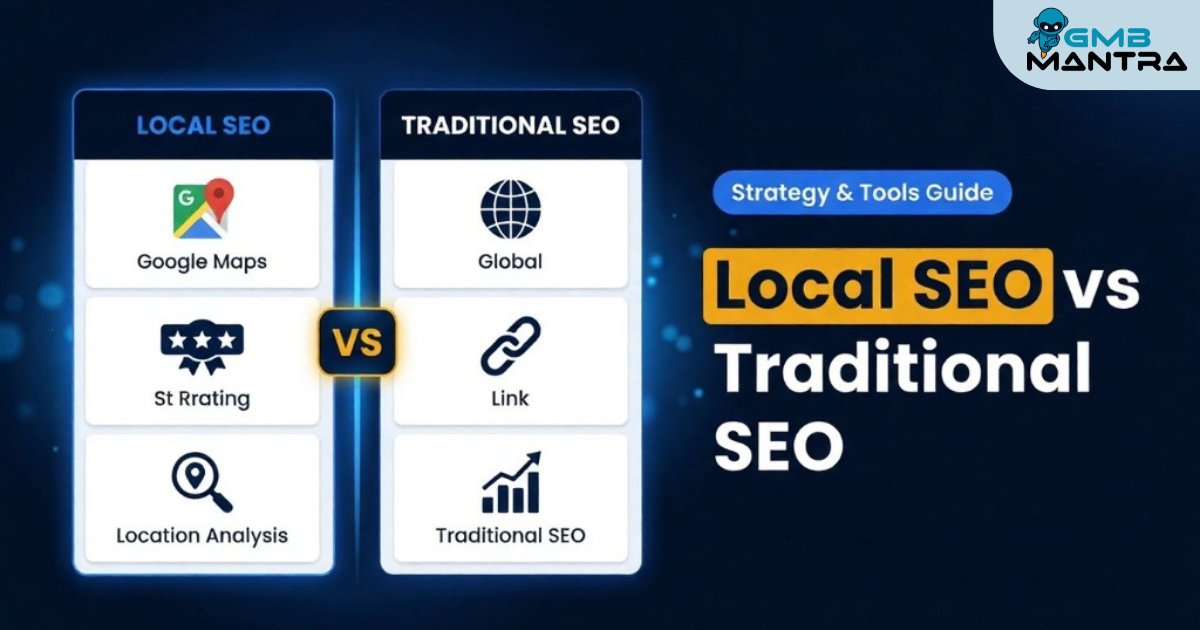
Local SEO vs Traditional SEO: Strategy & Tools Guide
Local SEO vs Traditional SEO: Link Building, Google Maps Optimization & What Actually Moves the Needle in 2026
Meta Title:
Local SEO vs Traditional SEO: Link Building & Maps Optimization (2026)
Meta Description:
Local SEO and traditional SEO demand different strategies in 2026. Get the breakdown on link building, Google Maps optimization, and hybrid tactics that drive real results.
When I talk to business owners about local SEO vs traditional SEO link building Google Maps optimization, I notice the same confusion keeps surfacing. They think it's one or the other. Pick a lane. But that's not how any of this works anymore—and honestly, it probably never did.
Here's what's changed: in 2026, the line between local and traditional SEO isn't blurring. It's been redrawn entirely. GBP performance, review velocity, proximity signals, and generative engine optimization have reshaped what "ranking" even means for a business that depends on foot traffic and online authority. If you're still running the playbook from even two years ago, you're bleeding visibility you don't even know about.
I've spent 20+ years in technology and over a decade building tools for service businesses. What I've seen lately is that the businesses winning aren't choosing between local and traditional. They're running hybrid strategies where Google Maps optimization feeds organic authority, and smart link building amplifies both.
So let me walk you through what's actually different, what's broken, and what to do about it.
How Does Local SEO Differ from Traditional SEO in 2026?
Local SEO drives foot traffic via GBP, reviews, and proximity signals in Map Packs—88% of local mobile searches convert to a call or visit within 24 hours—while traditional SEO builds global authority through backlinks and E-E-A-T content. In 2026, a hybrid approach wins for businesses of every size.
That stat isn't some inflated marketing number. It reflects a fundamental shift in how people search. "Near me" queries aren't just common—they're the default behavior on mobile. And Google's AI summaries are pulling from local sentiment analysis and problem-focused content to decide which businesses get recommended.
Traditional SEO still matters. Domain authority, topical depth, backlink profiles—these signals drive organic rankings for informational and commercial queries. But if you're a service business, a restaurant, a law firm, a salon… ignoring local costs you roughly 80% of high-intent mobile traffic. That's not a rounding error. That's the majority of your potential customers.
Here's the part most guides skip: these two systems now feed each other. A strong organic presence gives your GBP listing more credibility in AI overviews. And a well-optimized Google Maps profile generates the engagement signals (direction requests, calls, reviews) that strengthen your overall search footprint.
The 2026 Comparison: What Actually Matters
Google Maps Optimization: The Tactics That Actually Move Map Pack Rankings
This is where I see the biggest gap between what people think they should do and what's actually working.
Yes, you need NAP consistency across 50+ directories. That's table stakes. But in 2026, the businesses dominating the Map Pack are doing things most competitors still haven't figured out.
Review velocity is the single most underrated ranking factor right now. It's not about having 500 reviews. It's about the pace of new reviews coming in. A business getting 8-10 fresh reviews per week will outrank a competitor with twice the total count but stale activity. Google's local sentiment analysis is reading the tone of those reviews too—not just the star rating.
Here's what a solid Google Maps optimization workflow looks like as of 2026:
- GBP posting schedule: Weekly posts with geo-tagged images. The algorithm treats these as freshness signals. Use neighborhood-specific language, not generic city names.
- Geo-schema markup: JSON-LD structured data that tells Google exactly what services you offer, where, and for whom. This is the difference between appearing in the Map Pack and being invisible.
- Keyword strategy in your profile: Your business description, services, and Q&A section should reflect the actual phrases people use—"emergency plumber downtown" beats "plumbing services" every time.
- Review response cadence: Respond to every single review within 24 hours. Every. Single. One. Automated tools handle this at scale, but the response needs to feel personal.
- Visual search optimization: Upload high-quality, properly labeled images. AI-powered visual search is now pulling business photos into map results and voice search responses.
Tactile cue worth noting: When you update your GBP services section with geo-schema, the "Insights" tab should show a spike in discovery searches within 7-10 days. If it doesn't, your schema isn't being parsed correctly—check for nesting errors in your JSON-LD.
The Ghost Error Nobody Talks About
Here's a messy one I've seen come up repeatedly in forums: businesses with strong review profiles and clean NAP data that still can't crack the Map Pack. The culprit? What practitioners call "ghost suppression."
It happens when your geo-schema conflicts with your GBP category or when Google detects inconsistent structured data across your site and third-party directories. The listing doesn't get penalized visibly—it just… stops showing up for competitive queries.
The weird fix: Run a weekly schema audit using tools like LocalFalcon to check your map share metrics against competitors. Then embed hyper-local geo-schema on every service area page—not just your homepage. I know that sounds tedious. It is. But it's the difference between ranking #4 in the pack and not appearing at all.
Link Building for Local SEO: Why It's a Completely Different Game
Traditional link building—guest posts, editorial mentions, resource pages—still drives organic authority. But local link building operates on different logic entirely.
Local authority signals come from regional relevance, not domain rating. A link from your city's chamber of commerce, a neighborhood blog, or a regional news outlet carries more weight for Map Pack rankings than a DR-70 guest post on a national marketing blog.
Here's what I recommend for businesses trying to build links that serve both local and organic:
- Regional partnerships: Co-host events, sponsor local organizations, contribute to community publications. These generate contextual backlinks that Google associates with geographic relevance.
- Local resource pages: Get listed on "best of [city]" guides. These pages have high click-through rates and pass proximity signals.
- Problem-focused content that earns links naturally: Create neighborhood-specific cost breakdowns, service comparisons, or guides. (Example: "What does emergency HVAC repair actually cost in [neighborhood]?" pages get linked by local forums and Facebook groups constantly.)
- Supplier and vendor cross-linking: If you work with local suppliers, exchange contextual links on relevant pages. Not blogroll links—actual mentions within service descriptions.
The businesses I've seen gain the most ground in 2026 are the ones creating problem-focused content that AI summaries can pull from. When your page answers "How much does X cost in [specific area]?" with real numbers and specifics, it becomes the source that generative engines cite. That's GEO in practice—not some abstract concept, but content architecture that makes AI recommend your business.
> Your Local SEO Stack Shouldn't Be This Complicated > If you're juggling GBP posts, review responses, sentiment tracking, and local schema across multiple locations, you're probably spending hours on what should take minutes. We built GMBMantra to handle exactly this—AI-powered review responses, post scheduling, keyword heatmaps, and performance insights from a single dashboard. It's the back-office for your local SEO so you can focus on actually running your business.
The Ugly Truth: Why Most Local SEO Strategies Stall (And What to Fix First)
I was looking at the data recently and it's wild that businesses still lose 50%+ of potential conversions simply because a competitor has higher review velocity. Not better services. Not a better website. Just more recent reviews.
Here are the friction points I keep seeing:
AI overviews are ignoring most local businesses. If your content is generic—"We offer quality service at competitive prices"—AI summaries have nothing to cite. The fix is creating pages with specific cost breakdowns, neighborhood context, and practitioner-level detail. Think service area pages that read like they were written by someone who actually works in that zip code.
Mobile map conversions are dying from outdated directory data. One wrong phone number on a secondary directory tanks trust signals across your entire profile. Automate directory sync. Don't do it manually once a quarter and hope for the best.
Map share metrics are the conversion number nobody tracks. Impressions mean nothing if nobody's requesting directions or clicking to call. Track direction requests as your primary local KPI—it correlates directly with revenue in a way that organic traffic numbers never will.
Building a Hybrid Strategy That Actually Scales
For SMBs, the play is straightforward: lock down your GBP, build review velocity, and create 4-6 service area pages with geo-schema and neighborhood-specific content. Layer in local link building from regional sources. That's your foundation.
For larger brands or multi-location businesses, the complexity multiplies but the principles stay the same. Each location needs its own GBP optimization, its own review management workflow, and its own set of local authority signals. You can't just duplicate a template across 20 locations and expect results—proximity signals reward specificity.
The E-E-A-T local angle matters here too. Case studies, practitioner proof, before-and-after results on your site—these aren't just "nice to have" content. They're the experience signals that determine whether Google treats your business as a legitimate local authority or just another listing.
For a deeper breakdown of how local SEO and traditional SEO work together—and why specialized tools matter more than generic platforms—I'd recommend reading our full guide on why local SEO needs a specialized approach. It covers the strategic layer that sits underneath everything I've outlined here.
FAQs
How do I fix a stalled Google Maps ranking despite having good reviews? Check for geo-schema conflicts between your website and GBP categories. Run a weekly audit with LocalFalcon and ensure hyper-local structured data exists on every service area page—not just your homepage.
What's the fastest way to improve review velocity in 2026? Automate review requests via SMS or email within 2 hours of service completion. Respond to every review within 24 hours using sentiment-aware responses. Consistency matters more than volume spikes.
Should I prioritize local link building or traditional backlinks? Both, but weight them differently. For Map Pack rankings, regional citations and local partnerships move the needle faster. For organic rankings, editorial backlinks still drive domain authority. Build both simultaneously.
How do I get my business into AI-generated local recommendations? Create problem-focused content with neighborhood-specific details—cost breakdowns, service comparisons, and FAQ pages that directly answer "best [service] near [location]" queries. This is generative engine optimization in practice.
Can I use the same content strategy for multiple business locations? No. Each location needs unique service area pages with location-specific details, separate GBP optimization, and its own review management cadence. Duplicated templates get filtered out by proximity signals.
How often should I update my Google Business Profile posts? Weekly, minimum. Use geo-tagged images and location-specific language. Treat GBP posts like freshness signals—the algorithm rewards consistent activity over sporadic bursts.
What's the biggest local SEO mistake businesses make in 2026? Ignoring map share metrics and direction requests as KPIs. Most businesses obsess over impressions while their competitors track the actions that actually correlate with revenue—calls, directions, and booking clicks.
The gap between businesses that "do SEO" and businesses that drive actual foot traffic and revenue keeps widening. If you're reading this and realizing your strategy needs a serious update, start with your GBP and review velocity. Everything else builds on that foundation.
And if you want the tools to manage it without losing your weekends, GMBMantra is where I'd point you first.