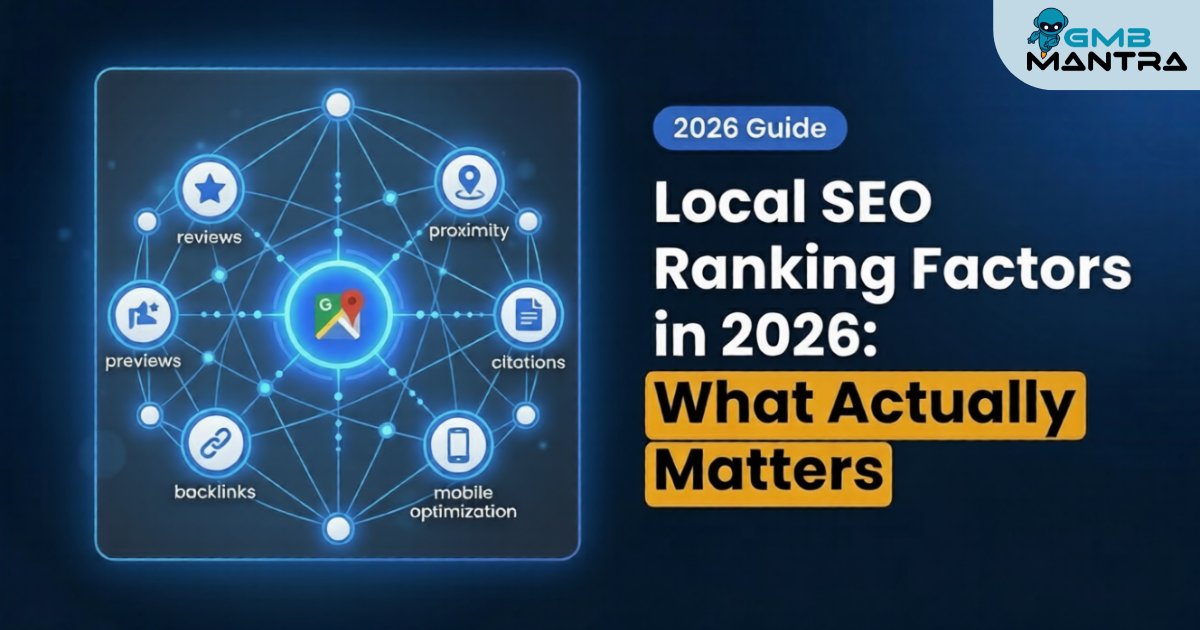
Local SEO Ranking Factors in 2026: What Actually Matters
I was staring at a client's Google Business Profile last month—a profile we'd spent six weeks optimizing—and their local pack visibility had dropped. Not a little. Tanked. The NAP was clean, the reviews were flowing, the schema was valid. And yet, nothing. It took me three days of digging through rank tracking data and running competitor analysis before I found it: a category misalignment that triggered what looked like a spam filter. One wrong secondary category.
That's local SEO in 2026. The stuff that breaks you isn't the stuff you forgot—it's the stuff you thought was fine.
By the end of this guide, you'll have a phase-by-phase system for auditing and fixing the local search ranking factors that actually move rankings this year, plus the local SEO tools to verify every step.
Before You Touch Anything: The Pre-Flight
You need three things locked down before any of this matters:
- Access to your GBP dashboard with owner-level permissions
- A rank tracking tool that monitors local pack positions at the ZIP-code level (not just city-wide)
- A citation management platform that can audit NAP across 50+ directories simultaneously
Stop/Go test: Can you pull up your current local pack position for your top 3 keywords right now? If not, stop here. Set up rank tracking first. Everything else is guesswork without it.
Phase 1: Entity Recognition — The Factor Nobody's Talking About Enough
Google's local algorithm has shifted hard. Proximity used to dominate. In 2026, proximity determines eligibility—whether you're even in the running. But entity recognition is what wins. The search engine needs to understand who you are, what you do, where you operate, and why you're trustworthy.
Here's what to do:
- Open your GBP. Look at your primary category. Is it singular and laser-focused? "Plumber" beats "Plumber & Handyman & Drain Cleaning Service" every time.
- Read your business description out loud. If it sounds like keyword soup, rewrite it in plain language.
- Check your service area map. It should show precise geographic coverage, not a vague blob covering three counties.
Visual checkpoint: Show your GBP to someone who's never heard of your business. Ask them: "What does this business do?" and "Where do they serve?" If they hesitate or give a vague answer, your entity clarity is broken.
Verification: They answer both questions correctly, instantly.
The nuance here: I've seen businesses with perfect profiles get crushed because their entity signals were muddied across the web. Your GBP says "dentist," but four old citations say "dental clinic" and two say "oral health center." Google doesn't know which entity you are. That's where citation management becomes non-negotiable—not just for NAP consistency, but for entity coherence.
Phase 2: The GBP Signals That Account for ~25% of Local Pack Rankings
Your Google Business Profile is still the single largest ranking factor, accounting for roughly 25% of local pack ranking signals. But "optimize your GBP" is vague advice. Here's what actually moves the needle in 2026:
- Complete all 13 core fields. Name, address, phone, website, category, hours, description, photos, service areas, attributes, posts, Q&A responses, review responses. All of them.
- Post 1-2 times per month. Not daily. I was looking at the data recently and it's wild—over-posting actually triggered spam flags for multiple businesses I tracked. Reduce frequency. Make each post count.
- Update your profile photo within the last 90 days. Stale profiles get deprioritized.
Visual checkpoint: Your posts appear in the "Updates" section with a consistent cadence. Your profile photo is current. All fields show data—no blanks.
Verification: Run a competitor analysis against the top 3 local pack holders for your primary keyword. Compare field completeness. You should match or exceed them on every single field.
Behavioral signals—clicks, calls, direction requests—account for about 10% of ranking weight. Which means a complete, engaging profile doesn't just rank; it converts.
Phase 3: Reviews — Velocity Over Volume
Here's the contrarian take: review count is almost a vanity metric now. Review velocity—the speed at which new reviews accumulate—is the stronger signal.
What to do:
- Stop chasing bulk review campaigns. Instead, build a system that generates 2-4 reviews per week, consistently.
- Train customers to mention specific services and locations in their review text. "Great roof repair in Buckhead" beats "Great service!" for local ranking signals.
- Respond to every review within 48 hours. 100% response rate. No exceptions.
Visual checkpoint: Your GBP insights show new reviews appearing weekly, not in monthly bursts.
Verification: Check your review timeline. If there's a gap longer than 10 days, your velocity system is broken.
(I know, asking customers to say specific things in reviews feels awkward. But you're not scripting them—you're prompting them. "We'd love to hear what service we helped you with" works.)
Phase 4: Hyperlocal Content & Link Relevance
Location pages with 800+ words of unique, neighborhood-specific content outperform thin, templated city-swap pages. This isn't new advice, but most businesses still get it wrong.
The fix:
- Reference local landmarks. Address area-specific problems. Write content a person in that neighborhood would actually recognize.
- Internal link each location page to relevant service pages. The structure should feel logical, not forced.
- Build backlinks from geographically and topically relevant sources—local news, Chamber of Commerce, industry directories. Link relevance carries significantly more weight than domain authority alone.
Visual checkpoint: Pull your location pages side-by-side. Each has 800+ unique words, 3+ location-specific references, and zero duplicate paragraphs.
Verification: If pages are less than 500 words or more than 70% identical, rebuild them.
Schema markup (JSON-LD, LocalBusiness type) needs to validate with zero errors in Google's Rich Results Test. NAP in your schema must match your footer, your contact page, and your GBP exactly.
The Ugly Truth: What Actually Trips You Up
Problem | The Weird Fix | Source |
|---|---|---|
Rankings dropped after GBP optimization | Remove mismatched secondary categories; reduce posting to 1-2x/month; wait 30 days | Community forums, GBP Help |
High impressions, zero conversions | Rewrite description in plain language; add 5+ service photos; narrow primary category | Practitioner testing |
Location pages ranking worse than homepage | Create 800+ unique words per page with local landmarks; don't template | SEO case studies |
NAP fixes not propagating | Audit citations quarterly; prioritize high-authority directories; accept some old ones persist | Citation management audits |
Schema present but no lift | Validate with Rich Results Test; ensure all required LocalBusiness fields are populated | Google documentation |
The pattern? Most "ghost errors" come from over-optimization or inconsistency that your local SEO tools should catch—but only if you're actually running audits regularly.
> Your Local SEO Stack Shouldn't Require 6 Different Dashboards If you're juggling separate tools for rank tracking, citation management, review responses, and competitor analysis, you're burning hours on context-switching. GMBMantra consolidates GBP management, AI-powered review responses with sentiment analysis, post scheduling, and keyword heatmaps into a single dashboard. It's what I recommend to practitioners who want to spend time on strategy, not tab-switching.
FAQ: The Implementation Questions That Actually Matter
How long does it take for GBP changes to affect local rankings?
Most GBP optimizations take 2-4 weeks to reflect in local pack positions. Category changes and description rewrites can trigger a re-evaluation period of up to 30 days. Track changes in your rank tracking tool weekly—don't panic before the 14-day mark.
How often should I audit my citations for NAP consistency?
Quarterly, minimum. Prioritize high-authority directories first—Chamber of Commerce, industry-specific platforms, and major aggregators. Use a citation management tool from GMBMantra to automate detection of inconsistencies across 50+ directories simultaneously.
Is local SEO worth the investment in 2026?
If your business serves a geographic area, it's not optional. The local pack captures the majority of clicks for service-intent queries. The real question is build vs. buy—are you handling this in-house or using a platform that automates GBP optimization and competitor analysis?
Why did my local rankings drop after getting more reviews?
Review velocity matters more than count. A sudden burst of 20 reviews in a week looks unnatural. Aim for steady, consistent review acquisition—2-4 per week. Also check if reviews are generic; keyword presence in review text strengthens topical authority signals.
How do I track if my local SEO strategy is working?
Monitor three metrics weekly: local pack position via rank tracking, branded search volume in Google Search Console, and GBP behavioral signals (calls, direction requests, clicks). If all three trend upward over 60 days, your local SEO framework is working.
So here's the real question: are you tracking the factors that matter, or the ones that are easy to measure? Because in 2026, the gap between those two things is where rankings are won and lost.
> Ready to consolidate your local SEO workflow?See how GMBMantra handles it—from rank tracking to review management to competitor insights, in one place.